Case Study: How an Autonomous Machine Vision System Increased Accuracy and Cut Waste

Case Study: How an Autonomous Machine Vision System Increased Accuracy and Cut Waste

The BSH Home Appliance Group (BSH) wanted to implement a quality assurance system to spot defects early on and reduce material waste, with the goal of cutting costs while benefiting the environment. The company found the perfect partner in Inspekto, the German-Israeli quality assurance specialist who invented Autonomous Machine Vision (AMV).
 
The BSH Appliance Group comprises 40 facilities worldwide and employs more than 62,000 people. Its commitment to sustainability is actualized in the production of energy-saving appliances, as well as in the reduction of the company’s environmental footprint in all areas of the value chain.
 
Like Inspekto, BSH is a firm believer in innovation through digitalization and 4.9% of the company’s spending is dedicated to research and development (R&D). As a result, the company established the BSH Startup Kitchen, an initiative that offers young companies the possibility to collaborate with BSH by offering their cutting-edge solutions to improve the company’s products and processes. The BSH Startup Kitchen tests promising new technologies and, following a successful pilot phase, offers the chance for a long-term business relationship.
 
“We have recognized that startups are a valuable source of innovative technologies and solutions for many of our business segments,” said Lars Roessler, venture partner at BSH Startup Kitchen. “BSH can apply such innovations directly in our product development and boost the productivity of our processes.”
 
One area where BSH intended to improve its existing processes is quality assurance (QA). As the systems in place still allowed some defected items to slip through, BSH was looking for a QA method that withheld the company’s strict quality standards without being too complex and cumbersome to deploy. As the need arose for an accurate, reliable, but user-friendly system, the BSH Startup Kitchen decided to approach Inspekto, the pioneer of Autonomous Machine Vision.

The challenge

 Automating QA allows manufacturers to save time and money. The cost of poor product quality is notorious—damage to a hard-earned reputation, erosion of customer trust, expensive recalls, material waste, and reworking costs are just some consequences of releasing defective products. For this reason, QA is a crucial step in every manufacturing process, regardless of industry size or sector. However, manual QA is not fit for the strict standards of Industry 4.0, since human inspectors may miss defects, especially when inspecting highly complex electrical items. On the other hand, traditional machine vision solutions are extremely expensive and complex to set up and maintain, making them unpractical for many manufacturers. BSH wanted to implement a reliable automated QA system but was struggling to find a satisfying solution.
 
“Even with multiple inspection check-ups, mistakes still emerged, thus increasing scrap-related costs,” explained Dipjyoti Deb, venture partner at BSH Startup Kitchen. “BSH had experimented with automated inspection solutions in the past, but each proved unsatisfactory and costly.”
 
BSH’s challenge was to increase the accuracy and efficiency of batch inspection processes, in a way that was simple and did not require the design and installation of a complex, customized project.
 
BSH Project Engineers Markus Maier and Stefan Schauberger were responsible for reducing the detection time of component defects at one of BSH’s oven manufacturing plants in Traunreut, Germany. They approached BSH Startup Kitchen with this problem, and a partnership with Inspekto was formed.

The solution

Inspekto is the inventor of AMV, a new approach to industrial QA that mimics the entire human vision process while retaining the reliability and repeatability of industrial machine vision.
 
Just as the human brain adapts our single optical system—our eyes—to each scenario, AMV adopts a single electro-optical system to fit a wide range of use cases. As a result, AMV systems are not tailor-made, case-specific solutions, but off-the-shelf products that come pre-trained for a wide variety of use cases, so that users can easily install and deploy them independently and in a very short time.
 
The user does not need to specify the parameters for image capturing, like the distance between the camera and the sample item, lighting, focus value, shutter speed, and exposure time—all of this will be automatically calculated and dynamically adjusted by the AMV system using its artificial intelligence (AI) engines. Users only need to present the system with 20 to 30 good sample items, so that it can learn the characteristics of the items to be inspected and flag any deviation from the memorized standards.
 
The user-friendliness and immediacy of AMV systems are the results of Autonomous Machine Vision Artificial Intelligence (AMV-AI), a proprietary technology that combines three AI modules to mimic the human cognitive vision process end-to-end. The first AI engine is in charge of dynamically adapting the electro-optics system to capture an optimal image of the part to be inspected, the second recognizes the item, and the third inspect it for defects. At all stages, the AI modules effectively mimic the human brain’s ability to acquire and process images, compare new images to ones that have been previously memorized, and spot differences.
 
Convinced by the user-friendliness and the accuracy of the technology, BSH implemented in its Traunreut plant the INSPEKTO S70, the only AMV system currently on the market.

The results

Thanks to Inspekto’s technology, the BSH plant in Traunreut was able to implement the user-friendly, immediately deployable solution they were looking for, without having to commission a lengthy, cost-prohibitive, and inflexible bespoke project.
 
What’s more, the INSPEKTO S70 can be trained quickly, adapt to environmental changes, and inspect multiple products and models simultaneously—all as an offline solution without any cloud deployment challenges.
 
“The result was so impressive that, while the solution was initially planned for only three use cases, it is now successfully tested and validated for six additional applications in different production lines,” confirmed Dipjyoti.
 
Crucially, the partnership with Inspekto allowed BSH to uphold its commitment to sustainability. The INSPEKTO S70 can be deployed at any point along the production line, not just at the end, helping the company spot defects early on. This means that precious resources are not wasted completing a product that is already damaged. It also means that the plant can pinpoint areas where defects happen more frequently and take action to improve the production process.
 
With the systems in place at the beginning of the assembly line, the Traunreut plant managed to cut material waste by up to 90%, helping the company save money while minimizing its environmental footprint.

(Courtesy of ISA/BSH Group/Inspekto)

Top Three Advantages of Integrated Explosion Protection Functionality

In every industry I can think of, exploding equipment is most certainly a bad thing. In process industry settings, however, the risk of explosions is very real. And the stakes–from impacts on revenue and the environment to loss of life–are far too great to ignore.

Engineers designing electrical equipment and processes for use in hazardous areas are offered a multitude of different methods for explosion protection. These range from exclusion methods, such as oil immersion or purge and pressurization, to containment in the use of explosion-proof or flame-proof enclosures, as well as energy limiting technologies, such as non-incendive, increased safety, or intrinsic safety. These principles and techniques have some inherent advantages and disadvantages. There are also some ideal applications, for example, protecting an entire control room using pressurization.

In the correct situation, however, intrinsic safety stands out as the safest, least expensive, and easiest to deploy. Let’s examine why.

1. Intrinsic safety is the safest form of explosion protection

First, intrinsic safety is the only method of explosion protection approved for Zone 0. This is the most hazardous area recognized by ATEX, IECEx, and NEC (article 505) and is considered hazardous “continuously.” The reason for this is that intrinsic safety is required to withstand two electrical faults and remain safe. It must also be immune to some of the issues arising from mechanical explosion-proof installations, such as improperly sealed conduits and damaged or improperly secured enclosures. In addition to superior safety from explosions, intrinsic safety is also inherently safer for personnel as its energy limiting principle typically only allows for up to 30 V or 100 mA to the hazardous area.

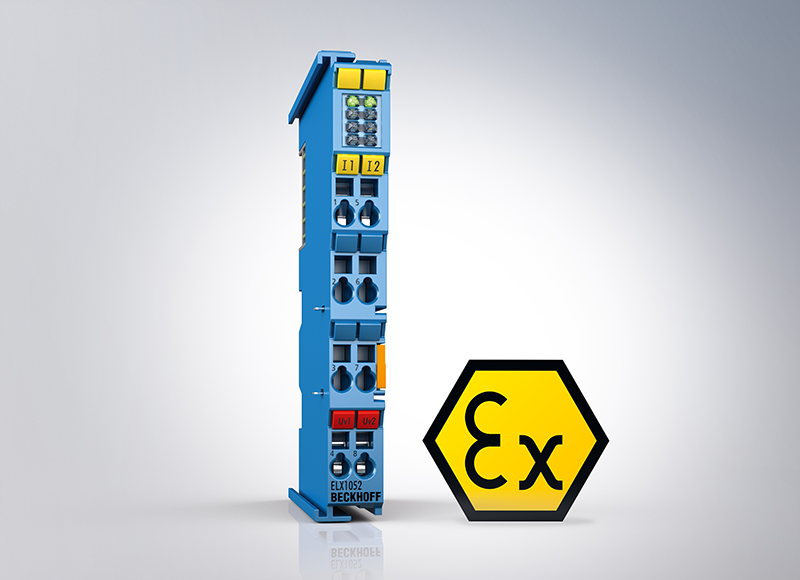
Intrinsic safety technology, such as the ELX EtherCAT Terminal series from Beckhoff, offers benefits in safety, cost, and ease of implementation.

2. Intrinsic safety is the least expensive way to implement explosion protection

In many cases, non-hazardous rated equipment can be used in an intrinsically safe circuit if it meets certain criteria. These devices are considered “simple apparatuses,” which means they are not capable of generating more than 1.5V, 100mA, or 1.5 W or they dissipate more than 2.5 W. These devices include thermocouples, switches, RTDs, and LEDs and are typically much less expensive and more readily available than hazardous area approved devices.

Another area in which intrinsic safety is less costly than other forms of explosion protection is the ongoing maintenance of the process or machine. Since they use energy limitation as an explosion protection concept, the devices in the hazardous area can be worked on without removing power. Additionally, maintenance time and effort can be significantly reduced because no gas clearance is required, and additional time is no longer needed to access electronics inside explosion-proof enclosures.

3. Intrinsic safety is the easiest explosion protection method to deploy

One of the biggest deployment advantages to intrinsic safety is the ability to use mostly safe area wiring practices. Of course, there are some wiring rules to follow, i.e., intrinsically safe and non-intrinsically safe wiring must be separated by 50 mm, and intrinsically safe wiring must be identified by a label or light blue cable jacket. However, all other aspects of wiring–when to use cable tray, types of glands, etc.–are similar to safe area wiring practices. This is in comparison to the multitude of rules regarding explosion-proof wiring installations, such as how and where conduit must be sealed as well as the type of cables and fittings required by the electrical codes. Intrinsic safety is also much easier to deploy than purge or pressurization systems as there is no need for a supply of inert gas to pressurize the enclosure nor the tubing and fittings associated with this gas supply.

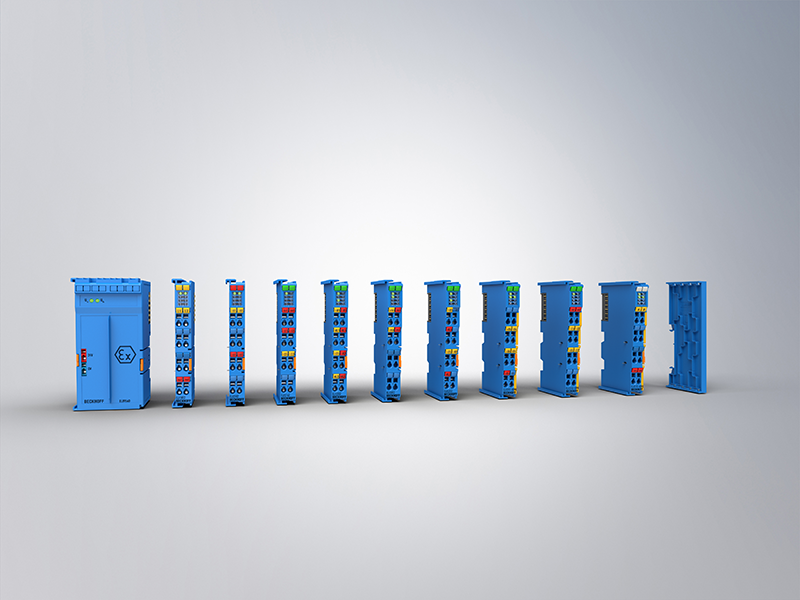
The ELX series offers a range of intrinsically safe “blue terminals” for hazardous environments, enabling communication from Zone 0 up to the cloud.

Exciting technological advancements in intrinsic safety technology are making these deployments even simpler. An example is the integrated intrinsic safety in new EtherCAT I/O terminals. These components combine explosion protection with a standard, DIN-rail-mounted I/O terminal. Other vendors offer some sort of integrated approach to explosion protection, but many results in different form factors than their non-ex counterparts, and they cannot be integrated directly into the same I/O node with non-ex terminals.
The integrated approach provides many other benefits. For starters, it eliminates the need for a third-party intrinsic safety barrier. This not only greatly reduces the size of the enclosure that houses the control system, but it also cuts the number of time-consuming wiring terminations in half. This also eliminates the need to add another vendor to the bill of materials. Another noteworthy benefit of these integrated technologies is that engineers can take advantage of all the benefits of EtherCAT technology, including:

  • Real-time communication speeds at 100 Mbit/s and the EtherCAT G/G10 Gigabit expansions will soon offer even greater bandwidth for demanding applications
  • Free selection of topology without any impact on performance
  • Practically no network size limitations, with up to 65,535 nodes on a single EtherCAT network
  • High synchronization due to the principle of distributed clocks
  • Make your applications intrinsically safe today

In terms of safety, cost, and ease of deployment, the benefits of intrinsic safety are clear, and I/O technology advances series make this even more obvious. Engineers should evaluate whether this method fits their application and implement it as appropriate. It’s also important to work with technology partners that take the risks just as seriously as you do and provide solutions to help keep your team, company, and equipment safe.

(Courtesy of ISA/Beckhoff Automation and Author: Jesse Hill)

Top 10 Essential Elements of a Successful DCS Upgrade or Migration

Modernizing your distributed control system (DCS) requires justification, an understanding of available technologies, and a systems integrator who has a deep understanding of your industry. DCSNext is the proven methodology for successful DCS migrations that takes you to step by step through the entire lifecycle of your plant.

(Picture Courtesy of MAVERICK: A Rockwell Automation Company)

This Top 10 list will help replace fear with facts as you consider an upgrade of your existing DCS, or a migration to a completely new platform.

View Mavtech Migration Top Ten List in PDF

1. Lifecycle Solution — A DCS upgrade or migration should deliver value throughout its entire lifecycle.
A successful migration project begins with strong front-end loading (FEL) that includes planning and budgeting with full lifecycle cost estimates. This best practice approach will help you implement your plan efficiently, locking in production gains through ongoing technical and operational services.

2. Solid Planning — Collaboration and planning are key to capturing process knowledge.
Involve your engineers, operators, IT personnel, and maintenance technicians in the FEL planning efforts. With everyone working together, you can build your project plan based on the FEL process, which is a best practice approach that uses a drill-down effect for efficiency. The resulting cutover plan – moving from the old to the new system – will minimize risk and maximize operational uptime.

3. Resource Availability — Choose a platform-independent automation solutions partner who understands your people, process, and technology.
You need a strong, qualified team, and your chosen third-party partner should be composed of migration project experts, able to sit down with you and bring their extensive experience and fresh ideas to the table. The right partner can help define your goals and be there at every stage. True collaboration ensures efficient communication and minimizes rework to keep you on time and on budget.

4. Funding — Develop a phased approach to spread the capital investment over a period of years.
Ask for budgetary estimates and total cost of operation (TCO) figures for different migration paths to get your funding approved and maximize ROI. Your trusted project partner will help you define the sequence of phases that best aligns with your facility’s needs and requirements. Strong upfront planning and realistic budgeting is a best practice that leads to a successful migration project.

5. Buy-in — Form strong partnerships with key internal stakeholders.
It is critical to keep everyone actively participating and engaged in the project to ensure a strong sense of ownership going forward. Early buy-in from operators and maintenance technicians is critical because they will work with the new system every day. A team approach ensures a high level of success overall.

6. Objectivity — Remove bias from the decision process.
A new control system platform is a major investment and is critical to operations. It is extremely important to have objective and unbiased vendor comparisons when it comes to controlling system platform selection. Be sure to involve all key stakeholders in upfront discussions, vendor evaluations, and project planning. It’s the only effective way to consider all your options and make the best selection.

7. Leveraging the Legacy — Preserve and leverage the positives of your legacy system.
Your existing system has many elements worth saving that can be combined with the new technologies being implemented. Much of your intellectual property and process knowledge can be incorporated into the new platform. This can reduce development costs while adding all the operational and safety features of the new system.

8. System Integration — The new or improved DCS must connect on many levels.
An effective partner will help integrate your improved DCS with other third-party systems. Required for operating and managing the facility, these systems often get overlooked until later in a migration project, which can be costly. The same improvements in HMI graphics and alarms incorporated into the new DCS can be extended to the information coming through these interconnections, improving operational effectiveness.

9. Risk Mitigation — Define your risks upfront, then eliminate them.
A systematic analysis early in the planning process can identify potential risk areas upfront. You and your chosen third-party partner should consider safety, downtime, resource allocation, network traffic levels, data integrity, cybersecurity, and other critical factors while there is still the greatest flexibility to deal with them.

10. Need-based Solution — Don’t assume you know the best approach for an upgrade or migration before you’ve studied the problem or potential roadblocks.
Consider best practices from a variety of industries and all viable options possible. Most important, carefully choose a savvy partner able to utilize their experience and technical depth to help you sort through all those decisions. You’ll get a custom-fit solution based on your needs, not the needs of the technology.

(Courtesy of MAVERICK Technologies: A Rockwell Automation Company)