Temperature switches can accept temperature sensor inputs from thermocouples (TCs) or resistance temperature detectors (RTDs) and provide multiple alarms at different settings or serve both alarm and equipment shutdown functions. The switch detects the temperature of an object. It uses bimetallic strips as the temperature-sensing element. When the switch senses minimum temperature it will be referred to as its “normal” status any sensed temperature below the trip threshold of the switch.
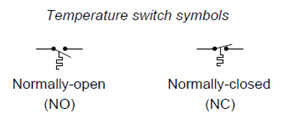
The temperature switches exhibit a certain amount of trip point or deadband in their switching action like all other process switches and reset at a lower temperature below the trip point. With mechanical switch designs, some amount of deadband is inevitable due to friction inside the mechanism. To understand the mechanism, consider whether the process variable is at or very near the trip point. Any further rise in temperature will trip the switch and sound the alarm. With trip point or deadband, the switch will immediately re-set when the temperature falls back down. The switch will “cycle” back and forth between its trip and reset states with just a minute change in process temperature. If the switch is activating an alarm every time it trips, it will create a series of alarm events to repeatedly acknowledge the operator and sounds the alarm. It is mandatory for the switch to trip at rising and remain in that tripped state until the temperature falls below the trip point. In this manner, it sounds alarmed only once rather than multiple alarm events for each process temperature excursion.
The mechanical switches come equipped with a separate adjustment for a trip point or deadband. Setting this dead band adjustment in a mechanical temperature switch requires the technician to repeatedly subject the sensing element to a rising and falling temperature, to check and verify that the switch trips and resets at the proper set point. When adjusting the “zero” and “span” settings of an analog transmitter we must repeat the process variable back and forth, checking to see that the transmitter repeatedly outputs a 0% signal at the lower range value (LRV) and a 100% signal at the upper range value (URV).
Temperature switches are used to energize and de-energize electric circuits as a function of the relationship between the process, temperature, and a predetermined set point. The set point error on the best electro-mechanical switches is about ± 0.5% of the span, but that error can rise substantially as the switching cost and quality drop. The sensing elements are mostly the elastic types including filled and bimetallic elements. The electric switching assemblies are either snap-acting mechanical micro-switches or mercury switches. The latter contains no mechanical moving parts and must be mounted on a vibration-free level surface.
Temperature switch elements should be selected with service life and maximum operating temperature in mind. Most elastic elements will have a service life of close to a million cycles if the cycle time is not less than 5s. The service life is related to the amount of current required to switch and the frequency of switching. By increasing the dead band, the frequency of switching is reduced and the life of the switch increases. Similarly, increasing the margin between the switch rating and the actual current flow handled will also increase switch life.
Moore Industries model SPA (“Site Programmable Alarm”) is an example of an electronic temperature switch module shown below. This temperature switch is capable of directly interpreting both RTD and thermocouple signals and input 4-20 mA loop current signals as well.
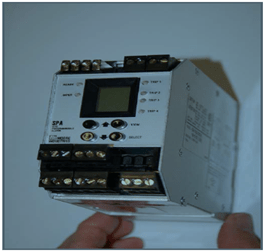
With electronic temperature switches, the adjustment of the trip point or deadband is both precise and flexible. Electronic switching circuits may be precisely set for any trip and reset points along with its measurement range, remaining very stable over time, unlike mechanical switches where a trip point or deadband is primarily a function of friction, and therefore liable to change over time.
The electrical rating of temperature switches at a 115V operating level varies from 0.3 to 10A on AC or DC circuits. Generally, the dual control and the fixed differential switches have lower ratings, and the double-adjustment-type units have higher ratings. The available circuit arrangements are very flexible. Some of the standard arrangements include single pole single throw, single pole double throw, and double pole double throw designs, but units are available with up to four poles.
There are basically three standard case designs: general purpose (NEMA 1), weather resistant (NEMA 2 and 3), and explosion-proof (NEMA 7) cases. These enclosures and the switches inside them may require certification to meet hazardous area classifications from certification agencies such as FM, CSA, or Underwriters’ Laboratories.
List of Prominent Suppliers: Ashcroft, Barksdale, Danfoss, Delta-Mobrey, Dwyer, Elettrotec , Engler, Fisher, Georigin, GHM Group, Hydac, Jumo, Labfacility, Neo-Dyn, New-Flow, Omega, PCI Instruments, Prisma, United Electric Controls, WIKA
 Instrumentation Basics