Temperature affects a change in electrical resistance and is the simplest class of temperature sensors. By considering this type of primary sensing element, a simple ohmmeter can function as a thermometer, interpreting the resistance as temperature measurement. RTDs are devices made of pure metal wire (usually platinum or copper) which always increase in resistance with increasing temperature.
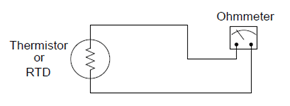
A Resistive Temperature Detector (RTD) is a special temperature-sensing element made of fine metal wire, the electrical resistance of which changes with temperature as approximated by the following formula:
RT = Rref [1 + α(T − Tref)]
Where,
RT = Resistance of RTD at given temperature T (ohms)
Rref = Resistance of RTD at the reference temperature Tref (ohms)
α = Temperature coefficient of resistance (ohms per ohm/degree)
Water’s melting/freezing point is the standard reference temperature for most RTDs. As mentioned previously, platinum is a common wire material for industrial RTD construction. The alpha (α) value for platinum varies according to the alloying of the metal.
For “reference-grade” platinum wire, the most common alpha value is 0.003902. Industrial-grade platinum alloy RTD wire is commonly available in two different coefficient values: 0.00385 (the “European” alpha value) and 0.00392 (the “American” alpha value), of which the “European” value of 0.00385 is the most used. 100 Ω is a very common reference resistance (Ref at 0 degrees Celsius) for industrial RTDs. 1000 Ω is another common reference resistance, and some industrial RTDs have reference resistances as low as 10 Ω.
A photograph of a modern temperature transmitter capable of receiving input from 2-wire, 3- wire, or 4-wire RTDs shows the connection points and the labeling describing how the sensor is to be connected to the appropriate terminals:

The rectangle symbol shown on the label represents the resistive element of the RTD. The symbol with the “+” and “−” marks represents a thermocouple junction and may be ignored for the purposes of this discussion. As shown by the diagram, a two-wire RTD would connect between terminals 2 and 3. Likewise, a three-wire RTD would connect to terminals 1, 2, and 3 (with terminals 1 and 2 being the points of connection for the two common wires of the RTD). Finally, a four-wire RTD would connect to terminals 1, 2, 3, and 4 (terminals 1 and 2 being common, and terminals 3 and 4 being common, at the RTD).
Once the RTD has been connected to the appropriate terminals of the temperature transmitter, the transmitter needs to be electronically configured for that type of RTD. In the case of this temperature transmitter, the configuration is performed using a “smart” communicator device using the HART digital protocol to access the transmitter’s microprocessor-based settings.
Self-heating error
One of the problems inherent to RTDs is self-healing. To measure the resistance of either device, we must pass an electric current through it. Unfortunately, this results in the generation of heat at the resistance. This dissipated power causes to increase in temperature beyond its surrounding environment, introducing a positive measurement error. The effect may be minimized by limiting excitation current to a bare minimum, but this results in less voltage dropped across the device. The smaller the developed voltage, the more sensitive the voltage-measuring instrument must be to accurately sense the condition of the resistive element. Furthermore, a decreased signal voltage means we will have a decreased signal-to-noise ratio, for any given amount of noise induced in the circuit from external sources.
One way to eliminate the self-heating problem without diminishing excitation current to the point of uselessness is to pulse current through the resistive sensor and digitally sample the voltage only during those brief time periods while the RTD is powered. This technique works well when we can tolerate slow sample rates from our temperature instrument, which is often the case because most temperature measurement applications are slow changing by nature.
List of Prominent Suppliers: Afrisco, Ametek, Amot, Anderson-Negele, Ashcroft, Azbil, Baumer, Carel, Chauvin Arnoux, Chino, Danfoss, Durex, Dwyer, Engler, Eltherm, EmcoControls, Focusens, GeOrigin, Honeywell, Hotset, Integra, Krohne, LakeShore, Lenord+Bauer, Ludwig, Minco, Montwill, Nanmac, New-flow, Nivelco, Noris, Noshok, Omega, Omet, Parker, Pixsys, Prisma, Reventec, Sensotec, Seneca, Sensata, Sitron, Steca, Supmea, Taisuo, Tecsystem, Texense, Thermokon, United Electric Controls, VentMatika, Watlow, WIKA
 Instrumentation Basics