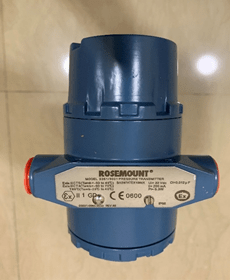
A pressure transmitter is a device that has been designed to measure pressure or level in liquids, fluids, or gases. Transmitters used in microprocessors include an input circuit, an analog-to-digital (A/D) converter that converts the sensor input into a digital signal. The microprocessor performs manipulation in ranging, linearization, and error checking and either transmits the reading digitally or sends the resulting value to the output digital-to-analog converter (D/A), which converts the signal back to an analog signal of 4–20 mA DC, 0–1 V DC, or 0–10 V DC.
The device converts the process pressure into a standard electrical signal by using electronic pressure sensors or transducers. The standard electrical signal is useful for indicating and controlling the process. The mechanical signal of the pressure is converted into a current (4-20 mA) electronic signal. The electronic signal pressure has a linear relationship, with the magnitude of the voltage or current, which is generally proportional. Therefore, the voltage or current outputted by the transmitter increases with the increase of the pressure and vice versa.
Power must be supplied to the transmitter circuit using the signal line (2-wire system). The transmitter quiescent consumption is 3.6 mA; during operation, consumption may be as high as 21 mA, depending on the measurement and sensor status. 4 mA corresponds to 0% of the working range and 20 mA to 100% of the working range.
Some Pressure Transmitter Types
- Gauge Type
- Differential Type
- Absolute Type
- Diaphragm Seal System Type
- Liquid Level Type
- Mass Flow Type
- Multi-Sensing Type
Calibration of a pressure transmitter involves zero and span adjustment. Exactness includes non-linearity, hysteresis, and repeatability effects and is indicated in % of the calibrated span. The pressure value is calculated in percentage taking into consideration the working range provided by the Lower Range Value (LRV) and the Upper Range Value (URV).
Range: It is the measurement limit that covers the minimum to the maximum pressure that the transmitter can measure.
Zero: It is the smallest pressure at which the transmitter was calibrated.
URV is the highest pressure at which the transmitter was set to measure with respect to the sensor’s upper range limit.
LRV is the lowest pressure at which the transmitter was set to measure with respect to the sensor’s lower range limit.
Span is the working range where the calibration is done The Span is equal to URV – LRV
“Turndown” is defined as the ratio of maximum allowable span to the minimum allowable span for a particular instrument.
Pressure Trim: The values obtained by Zero Pressure TRIM and Upper-Pressure TRIM may correct here the transmitter for long-term drift or the shift in zero or upper-pressure reading due to installation or overpressure.
Current Trim: The 4 mA TRIM and 20 mA TRIM adjustment is used to make the transmitter current comply with a current standard, should a deviation arise.
Pressure transmitters measure not only pressure levels but also differences in pressure. These are also very durable, being able to withstand nearly any environment and can, if needed, be completely submerged. Manufactured by considering safety measures as it may be installed in hazardous and extremely high-temperature zones. So, it should be approved by different non-profit organizations to comply with the safety standards (explosion-proof, intrinsically safe, ingress protection, etc).
Applications: Used in various industries like power, steel industry, petrochemical, oil and gas, water plants, chemical plants, food industries, etc.
List of Prominent Suppliers:
ABB Inc., Accutech, Ametek Inc., Anderson Instrument Co. Inc., Ashcroft Inc, Barton Instruments Systems, Bristol Babcock, Dresser Instrument, Druck Inc., Dwyer Instruments, Endress+Hauser Inc., Fisher Controls Int., Flow-Tech, Fuji Electric, The Foxboro Co., Gefran Spa, Honeywell Inc., Measurement Specialties, Mid-West Instrument, MKS Instrument, Nuova-Fima, OCI Instruments Inc., Omega Engineering, Parker Filtration, Palmer Instruments Inc., Phonetics, Rosemount Inc., Smar International, TSI Inc., Winters, Wika Instrument Corp., Yokogawa
 Instrumentation Basics