Basically, the pressure switch is a device that operates an electrical contact (open or closes a respective switch contact) when the preset fluid pressure is reached. The switch is designed in such a way that it makes contact either on pressure rise or on pressure fall corresponding to a certain preset pressure level. It uses diaphragms or bellows as the pressure-sensing element and its motion actuates one or more switch contacts.
Depending on the nature of the requirement it is mainly two types:
Operating principle:
The inlet pressure pushes the piston/diaphragm against a spring that has a known resistant force. Then, the piston triggers the micro-switch, moving it between normally closed (NC) and normally open (NO) positions through an operating pin and an insulated trip button.
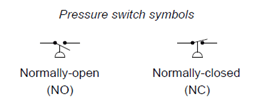
When a pressure switch senses minimum pressure, it will be referred to as in its “normal” status. Any fluid pressure below the trip threshold of the switch is referred as the “normal” status of the pressure switch.
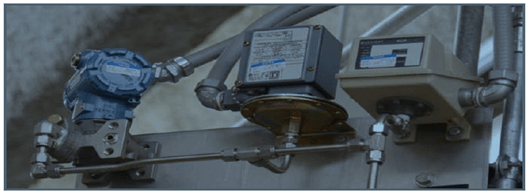
Two pressure switches as shown in the below photograph sense the same fluid pressure:
To set the pressure level at which the micro-switch switches between NC and NO, the trip-setting nut changes the spring pocket depth. To trigger the micro-switch which correlates to a set pressure, depth change allows the spring resistant force to increase or decrease. Inlet pressures create force upon the operating piston, generating a force opposing the range spring. When the inlet piston’s force is higher than the opposing spring force, it pushes the operating pin into the insulated trip button. The trip button then moves the micro-switch from NC to NO position. It breaks the connection, if the pressure decreases below the spring force, the button, pin, and piston move away from the micro-switch. The connection moves from the NO position to the NC position.
Consider the below factors at the time of selection:
Type of media: Housing and seal material should be compatible with the media type. Common media used with pressure switches are Hydraulic oil, Heating oil, Turpentine, Petrol/gasoline, Air, and Water.
- For the medium containing air and hydraulic/machine oil, nitrile butadiene rubber (NBR) is suitable.
- For water medium ethylene propylene diene monomer rubber (EPDM) is suitable.
Pressure: The switch must be able to withstand the maximum working pressure. For vacuum and low-pressure applications, the diaphragm design works well and for high-pressure applications, we use a piston design.
Temperature: The switch must be able to work well within its maximum and minimum temperature range.
Repeatability: It is the ability of the device to accurately switch back to the same set point for every repetition otherwise known as accuracy. The selection of the pressure switch will determine the range of accuracy required for the application. Compared to piston design, diaphragm designs generally provide more accuracy.
Hysteresis: It is the difference between the switch point and the reset point. If the reset point is too large, the switch stays active for a long time. The switch will flip between on/off state frequently if the reset point is too short.
Common applications:
Pressure switches are widely used in industrial technical processes to automatically supervise and control systems that use pressurized fluids. Pressure switches are in a wide range of industrial and residential applications like HVAC systems, well pumps, furnaces, HVAC, gas cylinders, air pumps, etc.
In the below photo shows a pressure switch manufactured by the Danfoss corporation:
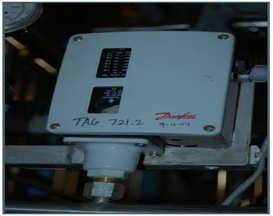
The force generated by a pressure-sensing element against a mechanical spring balances by the pressure switch. The tension on the spring and the trip point of this switch is adjustable.
There is one setting known as the dead band or differential pressure setting shown in the lower window on the switch. After the switch tripped, we have to reset the setting which determines the amount of pressure change required to bring it normal state.
 Instrumentation Basics