A diaphragm or capsule-type sensor is nothing more than a thin disk of material that bows outward under the influence of fluid pressure. As pressure is applied to the rear of the diaphragm, it distends upward, causing a small shaft to twist in response. This twisting motion is transferred to a lever that pulls on a tiny link chain wrapped around the pointer shaft, causing it to rotate and move the pointer needle around the gauge scale.

Pressure sensors that depend on the deflection of a diaphragm have been in use for over a century. In the last few decades, the elastic hysteresis, friction, and drift effects have been reduced to approximately ±0.1% of span in the high-quality designs. This has been achieved mostly using microprocessor technology in smart transmitters. What the microprocessor contributed to improving the performance of diaphragm-type sensors was its ability to recall from its memory the appropriate correction factors for the different values of diaphragm deflections.
Most pressure transmitters use a diaphragm as their pressure-sensing element.

Some instruments use the diaphragm as the pressure sensor; others use it as a component in a capsular element. The capsules consist of two diaphragms welded together at their peripheries. Two basic types of capsules are illustrated: the convex and the nested. Evacuated capsules are used for absolute pressure detection, and single diaphragms are used for highly sensitive measurements. The sensitivity of a capsule increases in proportion to its diameter, which in conventional designs. Multiple capsule elements can be built from either convex or nested capsules. These elements are useful in increasing the output motion resulting from a pressure change.
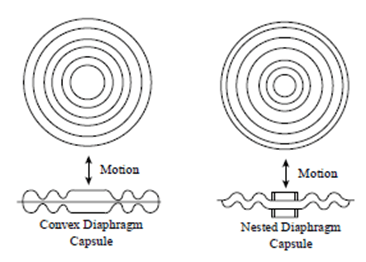
The diaphragm is a flexible disc, either flat or with concentric corrugations, that is made from sheet metal of precise dimensions. The pressure deflection characteristics of both flat and corrugated diaphragms have been well investigated.
Many diaphragms are constructed from metal, which gives them spring-like qualities. Some diaphragms are intentionally constructed out of materials with little strength, such that there is a negligible spring effect. These are called slack diaphragms, and they are used in conjunction with external mechanisms that produce the necessary restraining force to prevent damage from applied pressure.
Diaphragm materials with good elastic qualities, such as beryllium copper, and with very low-temperature coefficients of elasticity, such as Ni-Span C, are used. Inconel and stainless steel are used when extreme operating temperatures or a corrosive process requires them. Quartz diaphragms are used when minimum hysteresis and drift are desired. Materials of Construction: Buna-N, nylon, Inconel, Ni-Span C, phosphor bronze, 316 stainless steel, beryllium copper, Monel, brass, titanium, tantalum, Hastelloy, nickel, dura nickel, Teflon, Kel-F, polytetrafluoroethylene, CrNi, Ni-Cr-Co alloy.
List of Prominent Suppliers: Afriso, Ametek, Ashcroft, Barksdale, Druck, Dwyer, Gefran, Lefoo, Omega, Wika
 Instrumentation Basics