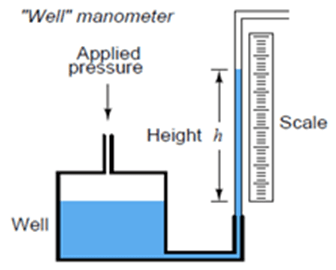
In this, the reading is measured by considering the height of the liquid column of a single vertical tube with respect to a large reservoir (called the “well”) acting as the second column. The cross-sectional area of the well is so much greater than the transparent manometer tube that the change in height within the well is usually negligible. In cases where the difference is significant, the spacing between divisions on the manometer scale may be adjusted to compensate by sliding the scale to zero to match this level.
The selection of the filling fluid depends on the chemical properties of the process materials it comes in contact with and also depends on process temperature (fill fluid may be frozen or vaporized). As the tube is made of glass or plastic, its use is discouraged for mechanical hazards. For this reason and the toxicity of mercury, glass tube mercury manometers are no longer used in the processing industries.

The standard construction materials for manometers include brass, steel, aluminum, and stainless steel for the metallic wetted parts, and Pyrex glass for the tube. Therefore, if the process material is toxic, hazardous, or should not be allowed to escape for other reasons, glass tube manometers should not be used, even at low operating pressures. The static pressure limitations apply only when the manometer detects pressure differentials.
List of Prominent Suppliers: Barksdale, BD Sensors, Brooks Instrument, Bsria, Dwyer, Flowtech, Kane, Hansa Flex, Mayuri Instruments, Meriam, New-Flow, PS Instruments, Sauermann, Trox Technik, TSI, TTseries
 Instrumentation Basics