
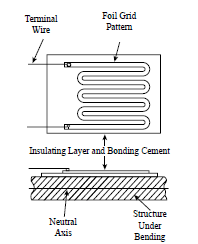
Piezoresistive means “pressure-sensitive resistance,” or a resistance that changes value with applied pressure. The strain gauge is an example of a piezoresistive element. A strain gauge must be bonded to a larger specimen capable of withstanding an applied force. The conductors of the strain gauge are deformed, as the test specimen is stretched or compressed by the applied force. The electrical resistance of any conductor is proportional to the ratio of length over the cross-sectional area (R ∝ l/A).

When we attach a strain gauge to a diaphragm, it results in a device that changes resistance with applied pressure. When the pressure is applied to the diaphragm, it will deform and causes the strain gauge to change resistance. We can calculate the amount of pressure applied to the diaphragm by measuring this change in resistance.

As the diaphragm bows outward with applied fluid pressure, the strain gauge deforms, causing its resistance to change. There is a voltage (Vout) proportional to the amount of applied pressure because of change in resistance causes imbalances in the bridge circuit. Hence, the strain gauge generally converts an applied pressure/force into a measurable voltage signal which may be amplified and converted into a 4-20 mA loop current signal.

An isolating diaphragm transfers process fluid pressure to the fill fluid, which will transfer pressure to the silicon wafer. As it must transfer fluid pressure from the process fluid to the fill fluid, the isolating diaphragm is designed to be much more flexible than the silicon diaphragm. Without having direct contact with the process fluid, the sensor achieves the same as it would if it were directly exposed to the process fluid.
List of Prominent Suppliers: BCM Sensor, BW Sensing, ElSHADDAI, HBM, Hytechmicro, Jewell Instruments, Kyowa, MinebeaMitsumi, RESENSYS, Rudrra, RST Instruments, Sense India, Zemic
 Instrumentation Basics