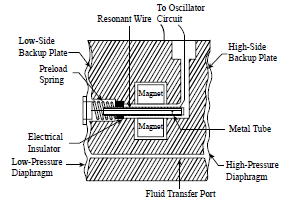
In the resonant wire pressure transducer, an oscillator circuit causes a wire to oscillate at its resonant frequency, while the wire tension is varied as a function of the process pressure. The resonant wire design is used to detect differential pressures. The process pressures are detected by the high-pressure and low-pressure diaphragms on the right and left of the unit. As the pressure difference rises, the fill fluid transmits a corresponding force to the wire, excited by the magnetic field. Backup plates support the diaphragms to prevent overpressure damage. The change in the wire tension modifies the resonant frequency of the wire, which is then digitally counted.
The advantages of this design include good repeatability, accuracy, stability, low hysteresis, high resolution, strong output signal, and the generation of an inherently digital signal, which can be sent directly to a stable crystal clock in a microprocessor. The limitations include sensitivity to ambient temperature variations, which requires built-in temperature compensation; a nonlinear output signal; and some sensitivity to shock and vibration.

List of Prominent Suppliers: Druck
 Instrumentation Basics