Mostly the simplest indicating instrument for liquid level in a vessel is level gauges. Even if another level-measuring instrument is present, level gauges/sight glasses are there to serve as a direct indicator for an operator to monitor in case there is doubt about the accuracy of the other instrument found in industrial level-measurement applications.
Basic concepts of sight glasses
As manometers are for pressure measurement, the level gauge, or sight glass is for liquid level measurement. It is a very simple and effective technology for direct visual indication of the process level. Generally, a level gauge is nothing more than a clear tube through which process liquid may be seen, directly mount to the vessel of which we want to measure the level. The following photograph shows a simple example of a sight glass:

A functional diagram of a sight glass shows how it visually represents the level of liquid inside a vessel such as a storage tank:

A level gauge is not unlike a U-tube manometer, with equal pressures applied to both liquid columns (one column being the liquid in the gauge sight glass, the other column being the liquid in the vessel). Level gauge valves exist to allow the replacement of the glass tube without emptying or depressurizing the process vessel. These valves are usually equipped with flow-limiting devices in the event of a tube rupture, so too much process fluid does not escape even when the valves are fully open. Some level gauges called reflex gauges are equipped with special optics to facilitate the viewing of clear liquids, which is problematic for simple glass-tube sight glasses.
Interface problems
As simple and apparently trouble-free as level gauges may seem, there are special circumstances where they will register incorrectly. One such circumstance is the presence of a lighter liquid layer existing between the connection ports of the gauge. If a lighter (less dense) liquid exists above a heavier (denser) liquid in the process vessel, the level gauge may not show the proper interface, if at all:
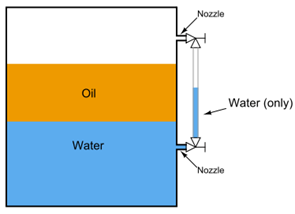
Here we see how a column of water in the sight glass shows less (total) level than the combination of water and oil inside the process vessel. Since the oil lies between the two-level gauge ports in the vessel (sometimes called nozzles), it cannot enter the sight glass tube, and therefore the level gauge will continue to show just water.
If by chance some oil does find its way into the sight glass tube – either by the interface level dropping below the lower nozzle or the total level rising above the upper nozzle – the oil/water interface shown inside the level gauge may not continue to reflect the true interface inside the vessel once the interface and total levels return to their previous positions:

Recall that the level gauge and vessel together form a U-tube manometer. So long as the pressures from each liquid column are the same, the columns balance each other. The problem is, that many different liquid-liquid interface columns can have the same hydrostatic pressure without being identical to one another:

The only way to ensure proper two-part liquid interface level indication in a sight glass is to keep both ports (nozzles) submerged:

Temperature problems
Another troublesome scenario for level gauges is when the liquid inside the vessel is substantially hotter than the liquid in the gauge, causing the densities to be different. This is commonly seen on boiler level gauges, where the water inside the sight glass cools off substantially from its former temperature inside the boiler drum:

Looking at the sight glass as a U-tube manometer again, we see that unequal-height liquid columns may indeed balance each other’s hydrostatic pressures if the two columns are comprised of liquids with different densities. The weighted density of water is 62.4 lb/ft 3 at standard temperature but may be as low as only 36 lb/ft 3 at temperatures common for power generation boilers.
List of Prominent Suppliers: ABB, Athena Engineering, Barksdale, Buhler, Clark Reliance, DDTop, DK Instruments, FlowTech, General Instruments, Gems, Klinger, Kobold, KFG Level, Krohne, Linex, Magnetrol, Mecon, Miselli, NewFlow, Nivelco, OHM Group, Prisma, PSI Instruments, Radix, Sasthan, Sensotec, Sigma, TecFluid, Trimod Besta, Tulpar, UKL, Val.Co, VEGA, Weka, Wika, Zetkama
 Instrumentation Basics