Hydrostatic pressure sensors may be used to detect the level of a liquid-liquid interface, if and only if the total height of liquid sensed by the instrument is fixed. A single hydrostatic-based level instrument cannot discriminate between a changing interface level and a changing total level, so the latter must be fixed to measure the former.
One way of fixing total liquid height is to equip the vessel with an overflow pipe and ensure that the drain flow is always less than the incoming flow (forcing some flow to always go through the overflow pipe). This strategy naturally lends itself to separation processes, where a mixture of light and heavy liquids is separated by their differing densities:
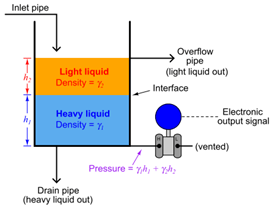
Here we see a practical application for liquid-liquid interface level measurement. If the goal is to separate two liquids of differing densities from one another, we need only the light liquid to exit out the overflow pipe and only the heavy liquid to exit out the drainpipe. This means we must control the interface level to stay between those two piping points on the vessel. If the interface drifts too far up, the heavy liquid will be carried out the overflow pipe; and if we let the interface drift too far down, the light liquid will flow out of the drainpipe. The first step in controlling any process variable is to measure that variable, and so here we are faced with the necessity of measuring the interface point between the light and heavy liquids.
Another way of fixing the total height seen by the transmitter is to use a compensating leg located at a point on the vessel always lower than the total liquid height. In this example, a transmitter with remote seals is used:
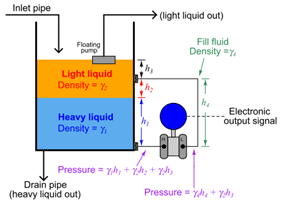
Since both sides of the differential pressure transmitter “see” the hydrostatic pressure generated by the liquid column above the top connection point (γ2h3), this term naturally cancels:
(γ1h1 + γ2h2 + γ2h3) − (γ4h4 + γ2h3)
γ1h1 + γ2h2 + γ2h3 − γ4h4 − γ2h3
γ1h1 + γ2h2 − γ4h4
The hydrostatic pressure in the compensating leg is constant (γ4h4 = Constant), since the fill fluid never changes density and the height never changes. This means the transmitter’s sensed pressure will differ from that of an uncompensated transmitter merely by a constant offset, which may be “calibrated out” to have no impact on the measurement:
γ1h1 + γ2h2 – Constant
At the first, it may seem as though determining the calibration points (lower- and upper-range values: LRV and URV) for a hydrostatic interface level transmitter is impossibly daunting given all the different pressures involved.
List of Prominent Suppliers: Aquas, Ametek, Anderson Negele, Aplisens, Autosen, BCM Sensor, Endress + Hauser, Flowtech, HolyKell, Huba Control, Jiucheng, Keller, LEEG, LTH Electronics, Nivelco, Noshok, Piezus, Prisma, Scaime, VEGA, ZHYQ
 Instrumentation Basics