In practice a displacer level instrument usually takes the following form, process piping in and out of the vessel has been omitted for simplicity – only the vessel and its displacer level instrument are shown:
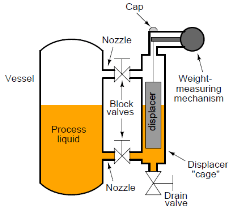
The displacer itself is usually a sealed metal tube, weighted sufficiently so it cannot float in the process liquid. It hangs within a pipe called a “cage” which is connected to the process vessel through two block valves and nozzles. These two pipe connections ensure the liquid level inside the cage matches the liquid level inside the process vessel, much like a sight glass.
If the liquid level inside the process vessel rises, the liquid level inside the cage rises to match. This will submerge more of the displacer’s volume, causing a buoyant force to be exerted upward on the displacer. Remember that displacer is too heavy to float, so it does not “bob” on the surface of the liquid, nor does it rise the same amount as the liquid’s level – rather, it hangs in place inside the cage, becoming “lighter” as the buoyant force increases. The weight-sensing mechanism detects this buoyant force when it “sees” the displacer becoming lighter, interpreting the decreased (apparent) weight as an increase in the liquid level. The displacer’s apparent weight reaches a minimum when it is fully submerged and when the process liquid has reached the 100 % point inside the cage.
It should be noted that static pressure inside the vessel will have a negligible effect on a displacer instrument’s accuracy. The only factor that matters is the density of the process fluid since buoyant force is directly proportional to fluid density (F = γV).
The following photograph shows a Fisher “Level-Trol” model pneumatic transmitter measuring condensate level in a knockout drum for natural gas service. The instrument itself appears on the right-hand side of the photo, topped by a grey-colored “head” with two pneumatic pressure gauges visible. The displacer “cage” is the vertical pipe immediately behind and below the head unit. Note that a sight glass level gauge appears on the left-hand side of the knockout chamber (or condensate boot) for visual indication of condensate level inside the process vessel:
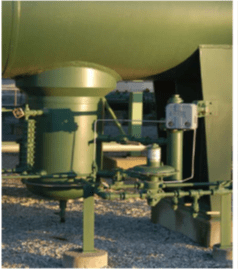
The purpose of this displacer instrument is to measure the amount of condensate liquid collected inside the “boot.” This model of Fisher Level-Trol comes complete with a pneumatic control mechanism that sends an air pressure signal to a drain valve to automatically drain the condensate out of the boot.
Two photos of a disassembled Level-Trol displacer instrument appear here, showing how the displacer fits inside the cage pipe:

The cage pipe is coupled to the process vessel through two block valves, allowing isolation from the process. A drain valve allows the cage to be emptied of process liquid for instrument service and zero calibration.
Some displacer-type level sensors do not use a cage, but rather hang the displacer element directly in the process vessel. These are called “cageless” sensors. Cageless instruments are of course simpler than cage-style instruments, but they cannot be serviced without de-pressurizing (and perhaps even emptying) the process vessel in which they reside. They are also susceptible to measurement errors and “noise” if the liquid inside the vessel is agitated, either by high flow velocities in and out of the vessel or by the action of motor-turned impellers installed in the vessel to provide thorough mixing of the process liquid(s).
Full-range calibration may be performed by flooding the cage with process liquid (a wet calibration), or by suspending the displacer with a string and precise scale (a dry calibration), pulling upward on the displacer at just the right amount to simulate buoyancy at 100% liquid level:

Calculation of this buoyant force is a simple matter. According to Archimedes’ Principle, the buoyant force is always equal to the weight of the fluid volume displaced. In the case of a displacer-based level instrument at full range, this usually means the entire volume of the displacer element is submerged in the liquid. Simply calculate the volume of the displacer (if it is a cylinder, V = πr²l, where r is the cylinder radius and l is the cylinder length) and multiply that volume by the weight density (γ):
Fbuoyant = γV, => Fbuoyant = γπr²l
Note how important it is to maintain the consistency of units! The liquid density was given in units of pounds per cubic foot and the displacer dimensions in inches, which would have caused serious problems without conversion between feet and inches. In my example work, I opted to convert density into units of pounds per cubic inch, but I could have just as easily converted the displacer dimensions into feet to arrive at a displacer volume in units of cubic feet.
List of Prominent Manufacturers: Azbil, Krohne, Magnetrol, Yafeng Instrument
 Instrumentation Basics