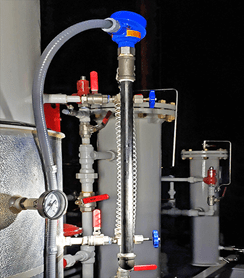
By considering the height of the fluid within a vessel, many industrial processes measure the level of fluid or solid (powder, granule, etc.). Some process vessels hold a stratified combination of fluids, naturally separated into different layers by virtue of differing densities, where the height of the interface point between liquid layers is of interest.
If a level instrument depends on motion (such as float, paddle, slip-tube, and tape types), if it has dead-ended cavities that might plug (such as some diaphragms, differential-pressure types, and sight gauges), if it will not operate properly when coated (such as some capacitance, conductivity, displacer, float, optical, and thermal types), or if a flow of a purge medium is required for its operation (bubbler type), it will be less reliable (more likely to require maintenance) than otherwise. Therefore, from a maintenance point of view, level sensors that do not make physical contact with the process material might be preferable. These include proximity capacitance, radar, laser, sonic and ultrasonic types, and sensors that can be located outside the tank, such as time-domain reflectometry (TDR) and microwave for fiberglass tanks, nuclear gauges, and load cells.
Certain factors, listed below, must be known to make an intelligent choice, regardless of who makes it:
- Maximum and minimum temperature and pressure (real, not “design”)
- Tank geometry, including nozzle dimensions & construction materials
- Process chemicals (no trade names); remember cleaning solutions
- Agitation horsepower and RPM
- Moisture range of granular solids
- Which phase is on top for interface measurements
Performance
This is a statement of maximum error that is usually obtained by measuring something other than level. With d/p transmitters, the “other” is usually air pressure. With capacitance, it is a high-precision capacitance box. With sonic and radar instruments, it is a handy wall. With displacers, it is precision weights. These results should be considered to be laboratory inaccuracy, which relates to the least possible error. It is achievable only in perfect applications, where the critical parameters are invariable.
The real-world variables that can multiply the inaccuracy include:
- Density variation for any of the density-sensing instruments
- Variations in the speed of sound resulting from the composition in the “air space” for sonic instruments
- Insulating coatings that change the speed of light for TDR instruments
- Conductive coatings on capacitance probes
- Any kind of coating for optical instruments
- Condensation on the antennas of radar instruments
Reliability
It is popular to confuse the mean time between failures (MTBF) for the electronic circuits with the expected trouble-free life of the total instrument. Because we are dealing with primary instruments, the effects of temperature extremes and cycling, and stress due to agitation, are more significant factors in the expected trouble-free life. The characteristics of the process materials (such as coating, foaming, density variation, and crystallization) can produce major errors in days or even hours.
Operating Principles
A wide variety of technologies exist to measure the level of substances grouped by sensing characteristics, those exploiting a different principle of physics.
- Density/Weight: Air bubblers, Differential-pressure (d/p) transmitters, Diaphragm (continuous) transmitters, Displacer transmitters, Load cells, Manometers, Radiation (nuclear) transmitters, Thermal dispersion
- Conductivity/Dielectric: Capacitance/RF transmitters, Conductance (continuous >2 MHz), Conductance (point-DC or low-frequency), Microwave switches, Radar, TDR (time domain reflectometry)
- Mechanical Contact: Diaphragm (point), Dipstick, Floats (cable connection), Floats (inductively coupled), Floats (magnet/reed relay), Floats (magnetostrictive pulse sensing), Paddlewheel (point), Plumb bobs (yo-yos), Resistance tape, Sonic/ultrasonic
- Optical: Lasers, Optical (photocell) switches, Level (sight) gauges
Applications
Level measurement applications can be broadly grouped in terms of service as atmospheric vessels and pressurized vessels. Except for liquefied gases, accounting-grade measurements are made in atmospheric vessels. These are a quantum leap in precision from the process control or material scheduling class of measurement.
 Instrumentation Basics