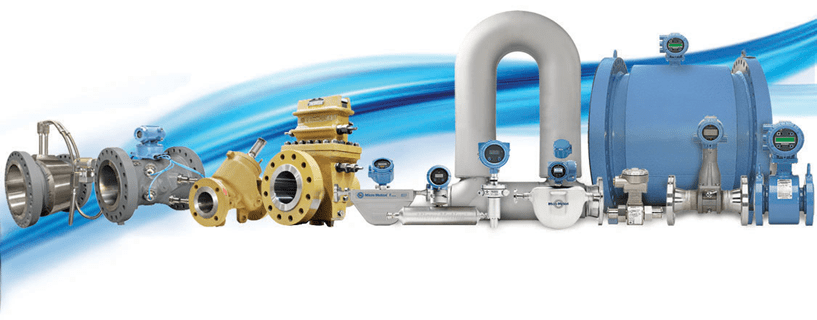
Flow measurement is the most complex among process variable measurements in instrumentation. Flow may be volumetric (fluid volumes passing by per unit time) or mass (fluid mass units passing by per unit time) or even standardized volumetric flow (the number of gas volumes flowing, supposing different pressure and temperature values than what the actual process line operates at). The dynamic properties of the fluids themselves change with flow rates. Most flow measurement technologies cannot achieve respectable measurement linearity from the maximum rated flow all the way to zero flow, no matter how well matched they might be to the process application.
Furthermore, the performance of most flowmeter technologies critically depends on proper installation. One cannot simply hang a flowmeter at any location in a piping system and expect it to function as designed. This is a constant source of friction between piping (mechanical) engineers and instrumentation (controls) engineers on large industrial projects. What might be considered an excellent piping layout from the perspective of process equipment function and economy is often poor (at best) for good flow measurement and visa-versa? In many cases, the flowmeter equipment gets installed improperly and the instrument technicians must deal with the resulting measurement problems during process unit start-up.
Even after a flowmeter has been properly selected for the process application and properly installed in the piping, problems may arise due to changes in process fluid properties (density, viscosity, conductivity), or the presence of impurities in the process fluid. Flowmeters are also subject to far more “wear and tear” than most other primary sensing elements, given the fact that a flowmeter’s sensing element(s) must lie directly in the path of potentially abrasive fluid streams.
Flowmeter Types:
- Pressure Based
- Laminar
- Variable Area
- Velocity Based
- Positive Displacement
- True Mass
- Coriolis
- Weightfeeder
- Insertion
Specifying the key requirements
Some important considerations are cost, accuracy, Reynolds number, safety, installation requirements, and special features such as reverse flow, pulsating flow, response time, etc.
Cost: Cost is a critical factor in the selection, such as operating costs, maintenance, spare parts inventory, the effect of downtime, and many others, should all be considered if a reasoned decision is to be reached.
Accuracy: Changes in fluid characteristics can also alter the meter’s performance.
Safety: All meter components must be certified as suitable for the applicable electrical area classification for the location at which they will operate by selecting intrinsically safe, flameproof, or explosion-proof devices.
Installation: The most demanding applications are ones in which the process flow cannot be stopped, and the measurement point cannot be bypassed.
 Instrumentation Basics