The flow capacity of a valve (Cv) is a quantitative rating of its ability to pass a fluid flow for a set of given pressure and density conditions. Cv may be predicted, or empirically measured, for any type of control valve given the proper information.
Not all control valve types exhibit the same Cv coefficients, however, for the same pipe size. A 4-inch butterfly valve, for example, has a much greater full-open Cv rating than a 4-inch globe valve, due to the much more direct path it offers to a moving fluid. A simple comparison of these two valve types clearly shows why this is true (note the “constriction” points labeled with arrows):
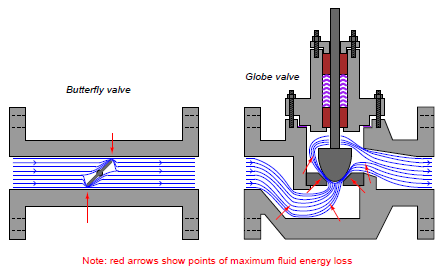
A globe valve is simply more efficient at generating fluid turbulence – and therefore dissipating fluid kinetic energy – than a butterfly valve of the same pipe size, because the globe valve design forces the fluid to change direction more often and in different ways.
One way to help quantify a particular valve design’s ability to throttle fluid flow is to express this ability as a ratio of flow coefficient (Cv) versus cross-sectional pipe area. The basic principle here is that we should expect the Cv of any particular valve design to be proportional to pipe area (e.g. a ball valve with twice the pipe area should have twice the flow capacity, all other factors being equal), and therefore a ratio of these two quantities should be fairly constant for any valve design.
Since we know the area of a pipe is proportional to the square of either radius or diameter (A = πd2/4 or A = πr2), we may simplify this ratio by omitting all constants such as π and simply relating Cv factor to the square of pipe diameter (d2). This ratio is called the relative flow capacity or Cd:

Several valve capacity factors (Cd) for different control valve types are shown here, assuming full-area trim and a full-open position:
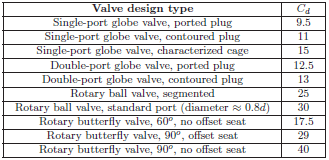
As you can see from a comparison of Cd values, a no-offset butterfly valve has nearly 4 times the flow capacity of a single-ported contoured-plug globe valve of the same pipe size (Cd = 40 versus Cd = 11). This makes butterfly valves advantageous in applications where large flow capacities must be achieved at minimal costs, such as in air handling (HVAC) systems for commercial buildings and combustion air controls for large industrial burners.
 Instrumentation Basics