Recall that an exothermic chemical reaction is one that releases a net sum of energy, as opposed to an endothermic reaction which requires a greater input of energy than it releases. Combustion is a common class of exothermic reactions, with the released energy being very obviously in the forms of heat and light, with heat being the predominant form.
Some exothermic reactions release energy primarily in the form of light rather than heat. The general term for this effect is chemiluminescence. A striking example of this reaction found in nature is the “cold” light emitted by North American species of firefly. In this small insect, a chemical reaction intermittently takes place emitting significant amounts of light but insignificant amounts of heat.
Certain industrial compounds engage in chemiluminescent reactions, and this phenomenon may be used to measure the concentration of those compounds. One such compound is nitric oxide (NO), an atmospheric pollutant formed by high-temperature combustion with air as the oxidizer.
A spontaneous chemical reaction between nitric oxide and ozone (an unstable molecule formed of three oxygen atoms: O3) is known to produce chemiluminescence:
NO + O3 → NO2 + O2 + light
Although this process of generating light is quite inefficient (only a small fraction of the NO2 molecules formed by this reaction will emit light), it is predictable enough to be used as a quantitative measurement method for nitric oxide gas. Ozone gas is very easy to produce on demand, by discharging an electric arc in the presence of oxygen.
A simplified diagram for a chemiluminescent nitric oxide gas analyzer appears here:
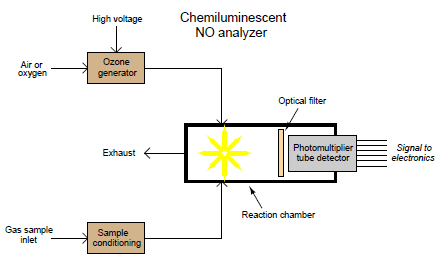
As with many optical analyzers, a photomultiplier tube serves as the light-detecting sensor, generating an electrical signal in proportion to the amount of light observed inside the reaction chamber. The higher the concentration of NO molecules in the sample gas stream, the more light will be emitted inside the reaction chamber, resulting in a stronger electrical signal produced by the photomultiplier tube.
Although this instrument readily measures the concentration of nitric oxide (NO), it is insensitive to other oxides of nitrogen (NO2, NO3, etc.). Normally, we would consider this selectivity to be a good thing because it would eliminate interference problems from these other gases. However, as it so happens, these other oxides of nitrogen are every bit as significant as nitric oxide (NO) from the perspective of air pollution, and when we measure nitric oxide for pollution monitoring purposes, we usually also wish to measure these other oxides in combination.
In order to use chemiluminescence to measure all oxides of nitrogen, we must chemically convert the other oxides into nitric oxide (NO) before the sample enters the reaction chamber. This is done in a special module of the analyzer called a converter:
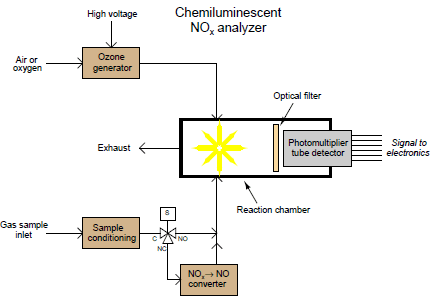
A three-way solenoid valve is shown in this diagram, providing a means to bypass the converter so the analyzer only measures nitric oxide content in the sample gas. With the solenoid valve passing all the samples through the converter, the analyzer responds to all oxides of nitrogen (NOx) and not just nitric oxide (NO).
One simple way to achieve the NOx → NO chemical conversion is to simply heat the gas to a high temperature, around 1300 degreeF. At this temperature, the molecular structure of NO is favored over more complex oxides. A disadvantage of this technique is that those same high temperatures also have a tendency to convert other compounds of nitrogen such as ammonia (NH3) into nitric oxide, thereby creating an unintended interference species.
An alternative NOx → NO conversion technique is to use a metallic reactant in the converter to remove the extra oxygen atoms from the NO2 molecules. One such metal that works well for this purpose is molybdenum (Mo) heated to the comparatively low temperature of 750 degreeF, which is too low to convert ammonia into nitric oxide. The reaction of NO2 converting to NO is as follows:
3NO2 +Mo → MoO3 + 3NO
Other oxides (such as NO3) convert in similar fashion, leaving their excess oxygen atoms bound to molybdenum atoms and becoming nitric oxide (NO). The only difference between these reactions and the one shown for NO2 is the proportional (stoichiometric) ratios between molecules.
As you can see from the reaction, the molybdenum metal is converted into the compound molybdenum trioxide over time, requiring periodic replacement. The rate at which the molybdenum metal depletes inside the converter depends on the sample flow rate and the concentration of NO2.
List of Prominent Suppliers: AeHealth, Autobio, Diasorin, Diatron, Dynex, Envea, Genrui, Horiba, PHC, Realytech, Seamaty, Servomex, YHLO
 Instrumentation Basics