Instrumentation is the science of automated measurement and controls of the process by manipulating the process parameters. Both the measurement device and the final control device are connected to the process and are controlled by the controller as per the requirement.
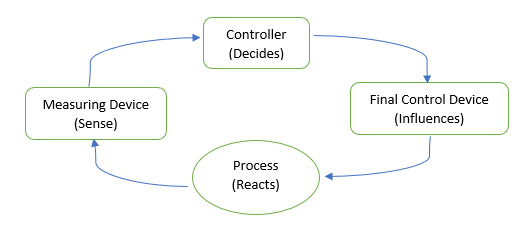
First step is always measurement and if we can’t measure, then there is no meaning of control the process as everything depends upon the measuring value.
For example Pressure, temperature, flow, volume, position, motion, acceleration, concentration, voltage, current, and resistance.
When we get the measured value, we transmit a signal representing this quantity to an indicating or computing device where either human or automated action then takes place. Where the controlling action is automated, the computer sends a signal to a final controlling device to act.
For example Control valve (for throttling the flow rate of a fluid), an Electric motor, an Electric heater.
What are the instrumentation terms that we used in industries regularly?
Process: The physical system where we measure and attempt to control. For example steam boilers, oil refinery units, power generation units, dm plants, iron and aluminum industries, etc.
Process Variable (PV): The specific quantity we measure in the process. For example pressure, level, temperature, flow, electrical conductivity, pH, position, speed, vibration.
Setpoint (SP): The specific value which we have to maintain the process, otherwise named as the target value.
Primary Sensing Element (PSE): A device that directs exposure to the process and senses the process variable then converts it to an analog signal for use. For example thermocouple, thermistor, bourdon tube, microphone, potentiometer, electrochemical cell, accelerometer.
Transducer: A device that converts the signal getting from the primary sensing element into another standardized instrumentation signal, and/or performs some sort of processing on that signal. For example I/P converter (converts 4-20 mA electric signal into 3-15 PSI pneumatic signal), P/I converter (converts 3-15 PSI pneumatic signal into 4-20 mA electric signal), square-root extractor (calculates the square root of the input signal).
Transmitter: A device that contains a transducer that translates the signal produced by a primary sensing element into a standardized instrumentation signal and then conveyed to an indicating device, a controlling device, or both. For example, 4-20 mA DC electric current, Fieldbus digital signal packet, etc.
Lower- and Upper-range values (LRV and URV): The values of process measurement are deemed to be 0% and 100% of a transmitter’s calibrated range. For example, if a temperature transmitter is calibrated to measure a range of temperature starting at 50 degrees Celsius and ending at 200 degrees Celsius, then 50 degrees would be the LRV and 200 degrees would be the URV.
Zero and Span: alternative descriptions to LRV and URV for the 0% and 100% points of an instrument’s calibrated range. “Zero” is the beginning point of an instrument’s range (equivalent to LRV), while “span” refers to the width of its range (URV − LRV). For example, if a temperature transmitter is calibrated to measure a range of temperature starting at 50 degrees Celsius and ending at 200 degrees Celsius, its zero would be 50 degrees and its span would be 150 degrees.
Controller: A device that receives a process variable (PV) signal from a transmitter, then compares that signal to the desired value for that process variable (called the setpoint) and calculates an appropriate output signal value to be sent to a final control element (FCE). For example an electric motor or control valve.
Manipulated Variable (MV): The output signal generated by a controller to achieve the set point. This is the signal commanding (“manipulating”) the final control element to influence the process.
Final Control Element (FCE): A device that receives the signal from a controller reacts directly or influences the process. Examples: variable-speed electric motor, control valve, electric heater.
Automatic mode: When the output is gathered by controller, the signal based on the relationship of the process variable (PV) to the setpoint (SP).
Manual mode: When the controller’s decision-making ability is bypassed to let a human operator directly determine the output signal sent to the final control element.
The common home thermostat is an example of a measurement and control system, with the home’s internal air temperature being the “process” under control. In this example, the thermostat usually serves two functions: sensing and control, while the home’s heater adds heat to the home to increase temperature, and/or the home’s air conditioner extracts heat from the home to decrease temperature. The job of this control system is to maintain air temperature at some comfortable level, with the heater or air conditioner taking action to correct temperature if it strays too far from the desired value (called the setpoint).
Follow to get updates and appreciate your valuable feedback!
 Instrumentation Basics