Relay control systems
The word “discrete” means individual or distinct. In engineering, a “discrete” variable or measurement refers to a true-or-false condition. Thus, a discrete control system is one designed to operate on Boolean (“on” or “off”) signals supplied by discrete sensors such as process switches.
A form of discrete control taught in every introductory course on digital electronics involves the use of circuits called logic gates. These circuits input one or more Boolean signals, and output a Boolean signal according to a simple rule such as “AND” or “OR”:
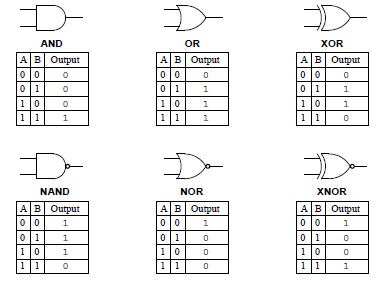
Industrial control systems rarely utilize logic gates in a direct fashion for discrete control systems, although the fundamental concepts of “AND,” “OR,” and other gate types are universally applied. Instead, control functions are implemented using electromechanical relays and/or programmable digital devices such as PLCs (Programmable Logic Controllers). This chapter focuses on the practical use of both technologies for discrete industrial control.
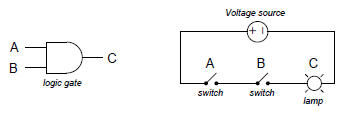
An “AND” function is equivalent to series-connected normally open contacts in a relay control circuit because the lamp will energize only if switch A and switch B are actuated:
An “OR” function is equivalent to parallel-connected normally open contacts in a relay control circuit because the lamp will energize if switch A or switch B is actuated:

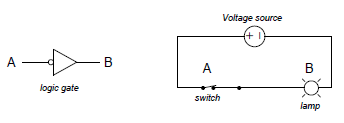
The “NOT” function is equivalent to a single normally closed contact in a relay control circuit because the lamp will energize only if the switch is not actuated:
 Instrumentation Basics