3-way solenoid valves have three ports for fluid, and like 2-way valves may be referred to either as normally open or normally closed. Ports on a pneumatic 3-way valve are commonly labeled with the letters “P,” “E,” and “C,” representing Pressure (compressed air supply), Exhaust (vent to atmosphere), and Cylinder (the actuating mechanism), respectively. Alternatively, you may see the cylinder port labeled “A” (for actuator) instead of “C”. Suppose the solenoid valve is intended for use in a hydraulic (liquid) system. In that case, the letter “T” is customarily used to identify the return port rather than “E” (Tank rather than Exhaust):
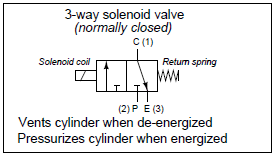

Alternatively, the numbers 1, 2, and 3 may be used to label the same ports. However, the numbers do not consistently refer to a pressure source (P) and exhaust (E) ports, but rather to the 3-way valve’s “normal” versus “actuated” statuses. A 3-way valve will pass fluid between ports 1 and 3 in its “normal” (de-energized) state, and pass fluid between ports 1 and 2 in its energized state. The following table shows the correspondence between port numbers and port letters for both styles of 3-way solenoid valve:

Another way to think of this labeling is to consider port 1 the common, port 2 the normally closed, and port 3 the normally open. Again, remember that the words “open” and “closed” do not mean the same for fluid valves as they do for electrical switches. A “normally-open” port on the valve permits fluid flow in its “normal” state, whereas a “normally-open” switch contact prevents electric current flow in its “normal” state.
As with 2-way solenoid valves, the arrows denote the preferred direction of fluid flow. Bidirectional 3-way valves will be drawn with double-headed arrows (pointing in both directions).
A different symbology is used in loop diagrams and P&IDs than that found in fluid power diagrams – one more resembling general instrumentation (ISA) valve symbols:
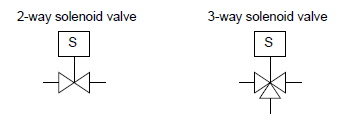
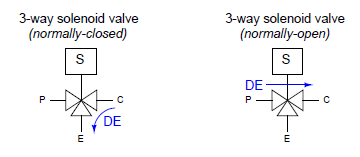
Regrettably, these symbols are not nearly as descriptive as those used in fluid power diagrams. To show directions of flow (especially for 3-way valves), one must add arrows showing “normal” (de-energized, DE) flow directions:
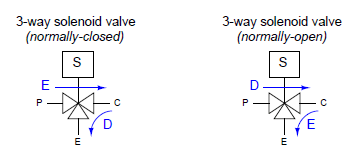
Alternatively, a pair of arrows show the directions of flow in both energized (E) and de-energized (D) states:
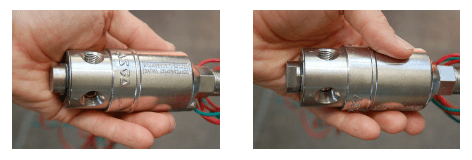
Photographs of an actual 3-way solenoid valve (this one manufactured by ASCO) appear here:
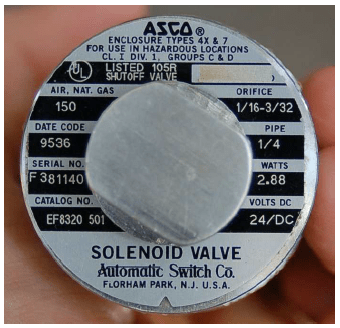
A view of the nameplate for this particular solenoid valve reveals some of its ratings and characteristics:
 Instrumentation Basics