Pneumatic (instrument air) systems must be free of water vapor and particulate contamination for much the same reason. Water is perhaps the most common contaminant in instrument air systems, causing corrosion of metal components and subsequent clogging of orifices. Special devices called air dryers are installed in instrument air systems to use solid materials called desiccants to absorb water entrained in the compressed air. The desiccant material is “regenerated” by the dryer mechanism on a regular cycle but must be periodically replaced when its water-absorbing ability wanes.
Pneumatic fluid power systems require cleanliness as well since any particulate contamination in the air will likewise cause undue wear in the close-tolerance compressors, motors, valves, and cylinders. Unlike hydraulic oil, compressed air is not a natural lubricant, which means many pneumatic power devices benefit from a small concentration of oil vapor in the air. Pneumatic “oilers” designed to introduce lubricating oil into a flowing air stream are generally located very near the point of use (e.g. the motor or the cylinder) to ensure the oil does not condense and “settle” in the air piping.
This next photograph shows a high-capacity industrial air dryer, with two large chambers holding desiccant:

A valving system directs air through one of these desiccant chambers at a time, allowing the desiccant to absorb water vapor in the air. Meanwhile, the new chamber is purged of its collected water by venting air through it into the atmosphere. An electronic timer unit (or PLC) controls the cycling of this valve system to ensure adequate drying and maximized desiccant service life.
Moisture content in instrument air is often expressed by the term dew point. This is the temperature at which water vapor suspended in the instrument air will condense into water droplets, at atmospheric pressure. The “drier” the air, the lower the dew point temperature; the “wetter” the air, the higher the dew point temperature. Sometimes the “dryness” of instrument air is expressed in terms of pressure dew point (PDP), which is the temperature of water condensation at system pressure rather than at atmospheric pressure. Pressure dew point is always a higher temperature value than atmospheric dew point since greater air pressures force condensation to occur at higher temperatures. Pressure dew point is a more practical value than atmospheric dew point for an instrument air system, as PDP directly indicates the ambient temperature at which water will condense in an operating pneumatic system. A low dew point value means that the air dryer is working as it should. A high dew point value means condensation is more likely to form in the compressed air system piping.
A simple way to help extract water from an instrument air system is an accessory called a water trap, usually found on air pressure regulators. The following photograph shows a Fisher pneumatic regulator equipped with such a trap on the bottom:

A shiny metal “wingnut” drain appears at the very bottom of the regulator, acting as a manual valve for purging collected water from the basin where compressed air enters the regulator mechanism. Periodic opening of this drain valve by maintenance or operations personnel allows collected water to be blown out of the regulator.
Another way to help minimize the amount of water reaching pneumatic devices is to properly orient all connections to the main air pipe (called a header). Ideally, each instrument air tap coming off a header should do so on the top, not the bottom. This way collected condensation inside the header will not go directly to the points of use, but rather will drain downhill to the lowest point in the header where a drain valve may be placed.
The following photograph shows an incorrect installation, where the air is drawn off the bottom of the main header line:

Such an installation invites trouble, as every bit of water condensed inside the header is guaranteed to find its way to the instruments connected to the underside of that header. One good feature of this installation is the use of stainless steel as the piping material. Copper, brass, plastic, and stainless steel are the preferred materials for instrument air piping, tubing, valves, and fittings, as the standard (iron) pipe will inevitably rust in the presence of condensation. Particles of rust created inside an instrument air system play havoc with the tiny ports, nozzles, and orifices of pneumatic instruments.
The proper way to make instrument air connections to the air header is as such:
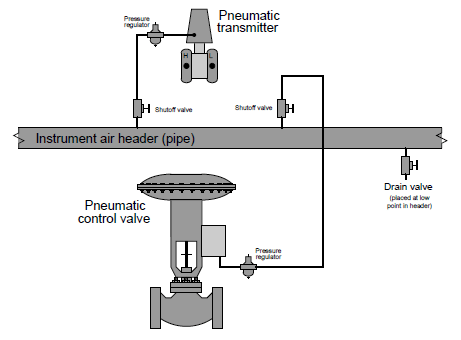
To facilitate draining of the header, the header should be slightly inclined, with the drain valve installed at the lowest point.
 Instrumentation Basics