Industrial IIoT: Transforming Operations with Data Communications

Industrial IIoT: Transforming Operations with Data Communications

The smartness of a factory lies in its ability to make optimal and timely decisions.

The Internet of Things (IoT) is a recent concept that originated out of the advancement and penetration of Internet services. The term IoT was first used by Kevin Ashton in 1999 to promote radio frequency identification (RFID) technology. It means smart devices with some computational capability are connected to the Internet and support sharing data in formats that can be used for further analysis. Day-to-day consumer examples of IoT devices include Alexa smart speakers, connected cars, and smart wearables.

When the application of IoT is extended to industrial use cases, it is called IIoT. It is also sometimes referred to as the “industrial Internet” or “Industry 4.0.” IIoT originated out of the commercial concept of the Internet of Things and the advancement and penetration of Internet services within industrial environments. The term “industrial Internet” reportedly was coined by GE for the convergence of critical assets, advanced predictive and prescriptive analytics, and modern industrial workers.

IIoT is a network of smart sensors, actuators, and systems using communication technologies that help in the real-time analysis and communication of data produced by the devices in the factories or fields. The ability to gather real-time data enables monitoring, exchange, and analysis of the data for meaningful insights. These insights are harbingers of smarter and faster business decision-making for manufacturing organizations.

In general, an IIoT ecosystem consists of the following (Figure 1):

  • connected smart devices that gather and communicate over a network
  • a public or private communications infrastructure
  • processes that analyze the data gathered by smart devices and produce business use information
  • data storage that houses data in a central location
  • people that consume the information to make informed decisions.
Figure 1: Industrial Internet of Things

IIoT enables the true convergence of information technology (IT) and operational technology (OT). The smart edge devices in the field or factories communicate the captured data intelligently over the communication infrastructure. The data is consumed to drive actionable information and trend analysis for machinery. The analyzed information supports informed decision-making for predictive maintenance, safety, security, and business optimization. 

An IIoT system with IT-OT convergence can be seen as a layered modular architecture of digital technology (Figure 2). It can be divided into four technology layers: 

Figure 2: A layered modular architecture of digital technology.
  • Content layer: People-interface devices like computer screens, tablets, smart glasses, and smart surfaces
  • Service layer: Applications and software to analyze data and transform it into actionable, insightful information
  • Network layer: Communication infrastructures such as Wi-Fi, Bluetooth, LoRa, 4G/5G cellular, and other methods that send and receive the data
  • Device layer: Smart edge devices, cyber-physical systems, sensors, actuators, and machines.

Trends and Standards

The growing adoption and multitude of players in the IIoT space have necessitated the development of standards. In 2020, the International Organization for Standardization (ISO) and the International Electrotechnical Commission (IEC) jointly released three IoT standards: 

  • ISO/IEC 21823-2 specifies a framework for transport interoperability to enable information exchange within and between IoT systems. 
  • ISO/IEC TR 30164 describes the concepts, characteristics, and technologies of edge computing for IoT systems applications. 
  • ISO/IEC TR 30166 applies to IIoT systems and landscapes.

In addition, the Industrial IoT Consortium has developed several volumes of architecture and specifications for IIoT. Sixteen consortia and associations and 17 standards development organizations are helping to define and standardize the IIoT environment.

An abundance of communication standards frameworks also exist. These include MQTT, a bidirectional TCP/IP–based publish-subscribe communication protocol; REST, a scalable Hypertext Transfer protocol used for edge-to-cloud communication; NodeRED, an open-source platform developed by IBM to connect APIs, hardware, and online services; OPC, a series of standards developed by the OPC Foundation for industrial communication to connect controllers with computers and the cloud; Chatty Things, an open framework being developed by XMPP Standards Foundation for scalable IIoT infrastructure; Cognitive IoT, a framework being developed by IBM that combines IoT with machine intelligence, contextual information, and learning using natural language processing; and Mindsphere, a cloud-based platform developed by Siemens to integrate IoT edge devices, applications, and services in one place. 

These standards and frameworks are shaping the IIoT landscape, as are Industry 4.0 reference architectures being developed around the world. Industrial Internet Reference Architecture (IIRA), the German Industrie 4.0, and the RAMI model are all independent efforts to create a defined standard for IIoT-enabled facilities.

Why IIoT is important now

IIoT has affected the industrial sector significantly and brought many benefits to digital manufacturing. The advancement in IoT technologies and the availability of the Internet have helped other advanced technologies, such as cloud computing, big data analytics, and artificial intelligence/machine learning, penetrate the industry. This has comprehensively contributed to a robust infrastructure for cyber-physical systems. The traditional industrial systems like supervisory control and data acquisition and distributed control systems have improved in monitoring, performance, productivity, and, more importantly, in efficiency with the advent of IIoT, contributing to the profitability of organizations.

The convergence of the physical devices over network infrastructures with smart edge devices, real-time analysis of data from the production process, visibility into process parameters, control of processes, and data exchange have all improved significantly. Overall, IIoT has enabled data-driven decision-making and positively affected the accuracy and predictability of these decisions in industrial environments.

Trends and benefits enabled by IIoT

Digitalization enabled by IIoT has been increasing rapidly during the past decade. According to a survey conducted by statista in 2020, the global market for IIoT was more than 263 billion USD. The market is expected to grow to some 1.11 trillion USD by 2028.

During the COVID pandemic, the adoption of IIoT-enabled technologies increased significantly. The remote work requirements were a push factor of this adoption. The focus of IIoT implementation in recent years has been workforce management initiatives, automation, and customer experience improvements. 

The advanced applications brought about by the proliferation of IIoT technology is the most significant trend associated with IIoT. This list was compiled by ATS

  • Remote monitoring and operation: The advantage of sensor-based data analytics is to access data and devices on demand.
  • Edge sensor advances: The edge capability and penetration of 4G/5G communications have enabled faster communication and robust sensors.
  • Predictive analysis: Data-driven trend analysis has improved on-time maintenance, reducing downtime and increasing production.
  • Digital twins: Smart sensor data feeds into digital twin models and makes remote monitoring and management more reliable and efficient.
  • Health and safety: IIoT-driven technologies contributed to health and safety, especially during the pandemic time in 2020–21. Employee locations on the facility floor, tracking of close contacts, and temperature recording all contributed to safe and healthy work environments.
  • Agile and flexible infrastructures: IIoT advances provide unprecedented flexibility in areas such as supply chain, so manufacturers can be agile in supplier selection, ordering and procurement strategy, and inventory management.
  • Smart factory: Increased penetration and use of 5G wireless communications within factories are taking digital manufacturing in new directions. Smart factories are a reality in 2022.
  • Data analysis at the source: The abundance of data generated by the smart edge devices makes it important to analyze the data at the source in a timely manner. Factories are changing their technical architecture, bringing data analysis and artificial intelligence (AI) technology out to the “edge” to take full advantage of the IIoT ecosystem.

The integration of IT and OT increased the speeds of Internet and communication technologies, and fast data analysis has supported the conversion of digital factories into smart factories. IIoT platforms integrate IT functions with OT functions and transform factory floor operations. The legacy machines and sensors are being integrated with the IT systems, and edge intelligence has been introduced. Lately, 5G penetration has accelerated this transformation by eliminating cabling and enabling ultra-reliable, mission-critical wireless communications.

The smartness of a factory lies in its ability to make optimal and timely decisions. Humans may or may not be part of such decisions. IIoT makes highly advanced technologies possible. For example, companies are adopting robotics and unmanned autonomous vehicles at deeper levels to augment or replace human workloads. Machine learning and artificial intelligence is being used to analyze data gathered by sensors and monitoring devices to make real-time decisions and improve the efficiency of production.

The huge operational advantages of smart factories are beginning to be realized as the pace of AI-driven process intelligence, blockchain-enabled supply chain management, and crypto-enabled edge security picks up. In the next few years, we will see the true transformation of factories as technologies like digital twins, the industrial metaverse, token-based economies, and algorithmic trust are enabled by lightweight edge computing. IIoT enables all that and more.

This feature originally appeared in InTech magazine’s August issue, a special edition from ISA’s Smart Manufacturing and IIoT Division.

About The Author

Shiv Kataria leads the IIoT committee within ISA’s SMIIoT Division. One of the focuses of this committee is to document best practices and frameworks and share the knowledge throughout the automation community. The use cases shared by the committee are from professionals working in IIoT areas who have been implementing IIoT for the digitalization of factories. Kataria is a research professional with Siemens Cybersecurity and Trust Research India. He is an electronics and communication graduate and holds certifications including CISSP, ISA/IEC 62443 Cybersecurity Expert, CEH, and ISMS 27001.

(Courtesy of ISA/IIoT and Author: Shiv Kataria)

Acromag’s Ethernet Remote I/O Modules Add Conditional Logic Computing

Acromag’s Ethernet Remote I/O Modules Add Conditional Logic Computing

Acromag’s new BusWorks NT series remote I/O modules are now enhanced with conditional logic. The conditional logic increases the functionality with a system of rules that allows extremely complicated decisions based on relatively simple “yes/no” questions. For example, reading an analog or digital input value can trigger an action to happen as a result. This value could control a relay when one or more conditions occur. Another example would be when a discrete input is ON and a temperature threshold is crossed. More complex math computation and logic are also an option.

Conditional logic is configured on the NT’s built-in web configuration page. No programming is required. The modules support up to 64 conditions using IF/THEN/ELSE statements.

NTE Ethernet I/O models have dual RJ45 ports and a webserver with Modbus TCP/IP and Ethernet/IP communication to monitor or control the internal I/O channels. An integrated DIN rail bus allows connections of up to three NTX expansion I/O modules. Each I/O module adds up to 16 input or output signals allowing a mix of voltage, current, temperature, TTL, and relay control signals networked on one IP address. The space-saving design requires only 25mm of DIN rail per module. Ethernet I/O modules distribute 9-32V DC power along the DIN rail bus to expansion modules. Hazardous location approvals, high noise immunity, and -40 to 70°C operation make this I/O ideal for use in harsh environments.

“With this new conditional logic capability, users can easily implement rule-based control functions without programming,” stated Robert Greenfield, Acromag’s business development manager.

The NT2000 Series offers a wide variety of I/O signal processing options. Nine I/O configurations are available as either NTE Ethernet I/O or NTX expansion I/O models. Analog I/O models feature eight differential or sixteen single-ended inputs for monitoring current or voltage signals. Discrete I/O models provide 16 tandem input/output channels with either active high/low input or sinking/sourcing output. A six-channel mechanical relay output model is also available. For temperature monitoring, a thermocouple input model supports many sensor types and also millivolt ranges. More models will release over the coming months for additional I/O functions.

Profinet communication is planned for release soon. Each module will support all three protocols which are selectable using any web browser to configure the network settings and I/O operation. The modules typically function as a network slave, but also offer Acromag’s i2o peer-to-peer communication technology to transfer data between modules directly without a host or master in between. Multicast capability is included.

Acromag, a mid-sized international corporation, has been developing and manufacturing measurement and control products for over 60 years. They offer a complete line of industrial I/O products including process instruments, signal conditioning equipment, data acquisition boards, distributed I/O systems, and communication devices.

(Courtesy of ISA/Acromag)

Softing’s SmartLink Product Family Offers Extended Functionalities for Plant Asset Management

Softing's SmartLink Product Family Offers Extended Functionalities for Plant Asset Management
Softing’s SmartLink Product Family Offers Extended Functionalities for Plant Asset Management

The SmartLink product family from Softing enables end customers to make efficient use of connectivity at the interface between OT and IT. The products allow simple and scalable integration of device data into plant asset management applications. The new versions of SmartLink HW-DP v1.20 and SmartLink SW-HT v1.20, which are now available, offer enhanced data transfer and connectivity functionalities.

SmartLink HW-DP – Integration of Industry 4.0 applications in PROFIBUS and HART systems

SmartLink HW-DP enables access to the process, asset, and diagnostic data from PROFIBUS devices and HART devices connected to PROFIBUS remote I/Os, as well as secure export to any system inside and outside the user’s own network. The new version v1.20 now supports providing asset and diagnostic data from field devices via MQTT. This allows easy integration into typical IoT system architectures, such as the Namur Open Architecture (NOA) or the IoT reference architectures of large cloud platforms.

SmartLink SW-HT – Data access via Emerson AMS Device Manager and other HART IP-enabled plant asset management applications

SmartLink SW-HT allows access to configuration and diagnostic data via Emerson’s AMS Device Manager or other HART IP-enabled Plant Asset Management applications. As the only solution available on the market, SmartLink SW-HT has so far supported Schneider Electric M580 controllers and drop I/Os as well as Allen-Bradley controllers and remote I/Os. Version v1.20 now also connects Emerson AMS Device Manager to HART devices connected to R.Stahl IS1+ remote I/O. More and more modern remote IOs are using Ethernet to connect to the controller. SmartLink SW-HT takes this trend into account by providing an Ethernet connection for tunneling HART commands to remote IOs. As a Docker container, SmartLink SW-HT can be managed via Kubernetes-based management platforms or services of the major cloud platforms.

Both new product versions expand the possibilities for end customers to implement open, standards-based, and scalable system architectures with the SmartLink product family and to integrate connectivity into ITmanaged edge solutions.

(Courtesy of ISA/Softing Inc.)

Five Keys to Powering Remote Wireless Devices

Five Keys to Powering Remote Wireless Devices

Battery-powered remote wireless devices are taking industrial automation to increasingly remote locations and extreme environments. The growing list of applications includes supervisory control and data acquisition (SCADA), process control, asset tracking and management, safety systems, field equipment status, flow monitoring, machine-to-machine (M2M), and artificial intelligence (AI), and wireless mesh networks.

Identifying the ideal power source for a remote wireless device requires a fundamental understating of each application’s unique power requirements, then selecting the ideal battery based on its performance capabilities.

This decision-making process typically centers around five key considerations:

  • Evaluating the device’s specific energy demands
  • Choosing the battery chemistry that best suits the needs
  • Understanding the importance of battery self-discharge
  • Adapting to high pulse requirements
  • Doing your homework

Evaluating device energy requirements

If a wireless device is easily accessible and operates within a reasonably mild temperature range, it may allow for the use of an inexpensive consumer-grade alkaline or lithium battery. However, the performance requirements for a battery are far different for long-term deployments in hard-to-access and hostile environments.

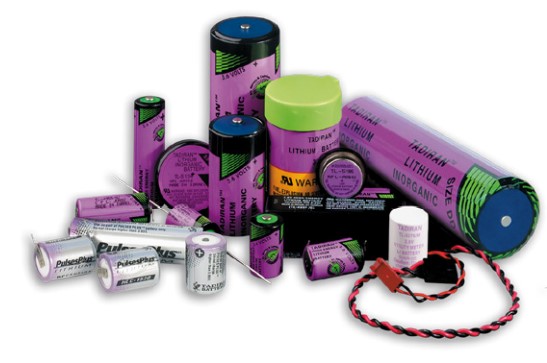
These devices must conserve energy by operating mainly in a standby state, drawing microamps of average current with periodic high pulses in the multi-amp range to power wireless communications. These low-power devices are predominantly powered by industrial-grade lithium thionyl chloride (LiSOCl2 ) batteries (Figure 1) that feature very high capacity, high energy density, an extended temperature range, and an exceptionally low annual self-discharge rate.

A relatively small number of remote wireless devices draw milliamps of average current with pulses in the multi-amp range, draining enough average energy to prematurely exhaust a primary (non rechargeable) battery. These niche applications are often better suited for an energy harvesting device in combination with an industrial grade Lithium-ion (Li-ion) battery to generate high pulses.

Choosing the best battery type for the application

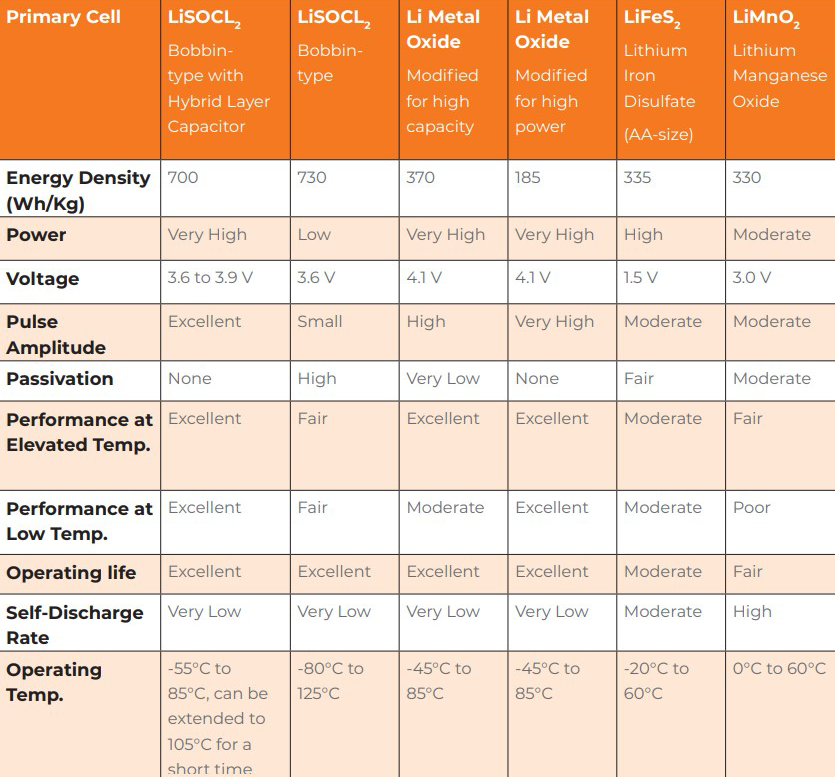
Numerous primary lithium battery chemistries are available (Table 1), each offering unique advantages and disadvantages. At one end of the spectrum are inexpensive alkaline batteries that deliver high continuous energy but suffer from a very high self-discharge rate (which limits battery life) as well as low capacity and energy density (which adds size and bulk). In addition to being short-lived, consumer-grade alkaline cells cannot operate in extreme temperatures due to their water-based constituents. For this reason, many remote wireless devices are powered by industrial-grade lithium batteries.

Figure 1: Bobbin-type LiSOCl2 batteries are preferred for remote wireless applications, delivering high energy density, up to 40- year service life, and the widest possible temperature range, making them ideal for use in inaccessible locations and extreme environments.
Table 1: Numerous primary lithium battery chemistries are available.

As the lightest non-gaseous metal, lithium features an intrinsic negative potential that exceeds all other metals, delivering the highest specific energy (energy per unit weight), highest energy density (energy per unit volume), and higher voltage (OCV) ranging from 2.7 to 3.6 V. Lithium battery chemistries are also non-aqueous and therefore less likely to freeze in very cold temperatures.

Among all commercially available primary lithium chemistries, bobbin-type lithium thionyl chloride (LiSOCl2 ) stands apart as being overwhelmingly preferred for ultra-long-term deployments. Bobbin type LiSOCl2 chemistry delivers the highest capacity and highest energy density of all endures extreme temperatures (-80°C to 125°C), and features an annual self-discharge rate as low as 0.7 percent per year that enables up to 40-year battery life. Bobbin-type LiSOCl2 batteries are specifically designed for use with low-power communications protocols such as WirelessHART, ZigBee, and LoRa, to name a few.

The main performance benefits of bobbin-type LiSOCl2 batteries include:

  • Higher reliability: Ideal for remote locations where battery replacement is difficult or impossible and highly reliable connectivity is required.
  • Long operating life: Since the battery’s self-discharge rate often exceeds actual energy usage, high initial capacity and a low self-discharge rate are often critical.
  • The widest temperature range: Bobbin-type LiSOCl2 cells can be modified to work reliably in extreme temperatures (-80°C to 125°C).
  • Smaller size: Higher energy density could permit the use of smaller batteries.
  • Higher voltage: Could allow for the use of fewer cells.
  • Lower lifetime costs: A critical consideration since the manpower and logistical expenses to replace a battery far exceed its cost.

Importance of battery self-discharge

A remote wireless device is only as reliable as its battery, so design engineers must specify the ideal power source based on a number of factors, including the amount of energy consumed in active mode (including the size, duration, and frequency of pulses); energy consumed in standby mode (the base current); storage time (as normal self-discharge during storage diminishes capacity); thermal environments (including storage and in-field operation); equipment cut-off voltage (as the battery capacity is exhausted, or in extreme temperatures, the voltage can drop to a point too low for the sensor to operate). Often, the most critical consideration can be the battery’s annual self-discharge rate, as the amount of current consumed by self-discharge can exceed the amount of energy required to operate the device.

All batteries experience some amount of self-discharge as chemical reactions draw current even while the cell is unused or disconnected. Self-discharge can be minimized by controlling the passivation effect, whereby a thin film of lithium chloride (LiCl) forms on the surface of the lithium anode, separating it from the electrode to reduce the chemical reactions that cause self-discharge. Whenever a current load is placed on the cell, the passivation layer causes initial high resistance and a temporary drop in voltage until the discharge reaction begins to dissipate the passivation layer—a process that continually repeats each time a load is applied.

Passivation can be affected by the cell’s current discharge capacity, the length of storage, storage temperature, discharge temperature, and prior discharge conditions, as partially discharging a cell and then removing the load increases the level of passivation over time. Controlling passivation is ideal for minimizing self-discharge but too much of it can overly restrict energy flow.

Competing bobbin-type LiSOCl2 cells vary considerably in terms of their self-discharge rate. For example, the highest quality LiSOCl2 batteries can feature a self-discharge rate as low as 0.7% per year, able to retain nearly 70 percent of their original capacity after 40 years.

Conversely, lower-quality LiSOCl2 cells can have a self-discharge rate as high as 3 percent per year, exhausting nearly 30 percent of their available capacity every 10 years, limiting maximum battery life to 10-15 years.

Adapt for high pulse requirements

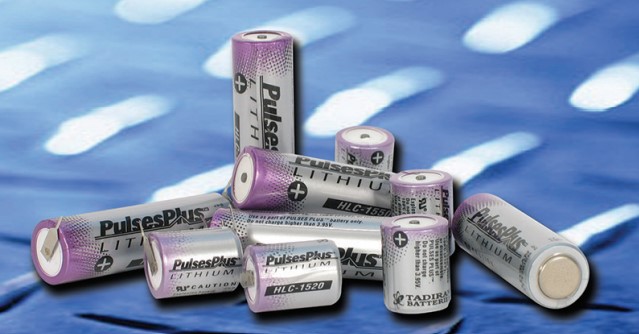
To support two-way wireless communications and other advanced functionality, remote wireless devices must generate periodic high pulses up to 15 A. Standard bobbin-type LiSOCl2 cells normally cannot deliver high pulses due to their low-rate design. However, they can be easily modified with the addition of a patented hybrid layer capacitor (HLC) (figure 2). This hybrid solution uses the standard bobbin-type LiSOCl2 cell to deliver low-level background current during standby mode while the HLC delivers the high pulses required to support data queries and transmission. As an added benefit, the HLC features a unique end-of-life voltage plateau that can be interpreted to deliver low battery status alerts.

Supercapacitors perform a similar function to consumer products but are generally ill-suited for industrial applications due to serious limitations including short-duration power, linear discharge qualities that do not allow for the use of all available energy, low capacity, low energy density, and very high self-discharge rates up to 60 percent per year. Supercapacitors linked in series require the use of expensive cell-balancing circuits that add bulk and drain additional current to further shorten their operating life.

Figure 2: Bobbin-type liSOCl2 batteries can be combined with a patented hybrid layer capacitor (HLC) to deliver up to 40-year service life along with the high pulses required for two-way wireless communications.

Do your homework

When designing for long-term deployment in a highly remote location or extreme environment, it pays to spend a little more for a superior grade battery that can last for the entire lifetime of the device, thus eliminating the need for costly battery change-outs. Accomplishing this cost-saving goal requires careful due diligence as lithium batteries are not created equal.

For example, the annual self-discharge rate of a bobbin-type LiSOCl2 battery can vary significantly based on how it is manufactured and the quality of the raw materials. Unfortunately, a lower quality cell with a high self-discharge rate may be hard to distinguish as capacity losses are not easily measurable for years and theoretical battery life expectancy models tend to underestimate the passivation effect as well as long-term exposure to extreme temperatures.

To properly compare competing battery brands, users must demand fully documented and verifiable test results along with in-field performance data under similar loads and environmental conditions. Learning about the subtle differences between seemingly identical cells can pay huge dividends by reducing your long-term cost of ownership.

This feature originally appeared in the ebook Automation 2022: IIoT and Industry 4.0 (Volume 3).

(Courtesy of ISA/Tadiran Batteries and Author: Sol Jacobs)

Case Study: How an Autonomous Machine Vision System Increased Accuracy and Cut Waste

Case Study: How an Autonomous Machine Vision System Increased Accuracy and Cut Waste

The BSH Home Appliance Group (BSH) wanted to implement a quality assurance system to spot defects early on and reduce material waste, with the goal of cutting costs while benefiting the environment. The company found the perfect partner in Inspekto, the German-Israeli quality assurance specialist who invented Autonomous Machine Vision (AMV).
 
The BSH Appliance Group comprises 40 facilities worldwide and employs more than 62,000 people. Its commitment to sustainability is actualized in the production of energy-saving appliances, as well as in the reduction of the company’s environmental footprint in all areas of the value chain.
 
Like Inspekto, BSH is a firm believer in innovation through digitalization and 4.9% of the company’s spending is dedicated to research and development (R&D). As a result, the company established the BSH Startup Kitchen, an initiative that offers young companies the possibility to collaborate with BSH by offering their cutting-edge solutions to improve the company’s products and processes. The BSH Startup Kitchen tests promising new technologies and, following a successful pilot phase, offers the chance for a long-term business relationship.
 
“We have recognized that startups are a valuable source of innovative technologies and solutions for many of our business segments,” said Lars Roessler, venture partner at BSH Startup Kitchen. “BSH can apply such innovations directly in our product development and boost the productivity of our processes.”
 
One area where BSH intended to improve its existing processes is quality assurance (QA). As the systems in place still allowed some defected items to slip through, BSH was looking for a QA method that withheld the company’s strict quality standards without being too complex and cumbersome to deploy. As the need arose for an accurate, reliable, but user-friendly system, the BSH Startup Kitchen decided to approach Inspekto, the pioneer of Autonomous Machine Vision.

The challenge

 Automating QA allows manufacturers to save time and money. The cost of poor product quality is notorious—damage to a hard-earned reputation, erosion of customer trust, expensive recalls, material waste, and reworking costs are just some consequences of releasing defective products. For this reason, QA is a crucial step in every manufacturing process, regardless of industry size or sector. However, manual QA is not fit for the strict standards of Industry 4.0, since human inspectors may miss defects, especially when inspecting highly complex electrical items. On the other hand, traditional machine vision solutions are extremely expensive and complex to set up and maintain, making them unpractical for many manufacturers. BSH wanted to implement a reliable automated QA system but was struggling to find a satisfying solution.
 
“Even with multiple inspection check-ups, mistakes still emerged, thus increasing scrap-related costs,” explained Dipjyoti Deb, venture partner at BSH Startup Kitchen. “BSH had experimented with automated inspection solutions in the past, but each proved unsatisfactory and costly.”
 
BSH’s challenge was to increase the accuracy and efficiency of batch inspection processes, in a way that was simple and did not require the design and installation of a complex, customized project.
 
BSH Project Engineers Markus Maier and Stefan Schauberger were responsible for reducing the detection time of component defects at one of BSH’s oven manufacturing plants in Traunreut, Germany. They approached BSH Startup Kitchen with this problem, and a partnership with Inspekto was formed.

The solution

Inspekto is the inventor of AMV, a new approach to industrial QA that mimics the entire human vision process while retaining the reliability and repeatability of industrial machine vision.
 
Just as the human brain adapts our single optical system—our eyes—to each scenario, AMV adopts a single electro-optical system to fit a wide range of use cases. As a result, AMV systems are not tailor-made, case-specific solutions, but off-the-shelf products that come pre-trained for a wide variety of use cases, so that users can easily install and deploy them independently and in a very short time.
 
The user does not need to specify the parameters for image capturing, like the distance between the camera and the sample item, lighting, focus value, shutter speed, and exposure time—all of this will be automatically calculated and dynamically adjusted by the AMV system using its artificial intelligence (AI) engines. Users only need to present the system with 20 to 30 good sample items, so that it can learn the characteristics of the items to be inspected and flag any deviation from the memorized standards.
 
The user-friendliness and immediacy of AMV systems are the results of Autonomous Machine Vision Artificial Intelligence (AMV-AI), a proprietary technology that combines three AI modules to mimic the human cognitive vision process end-to-end. The first AI engine is in charge of dynamically adapting the electro-optics system to capture an optimal image of the part to be inspected, the second recognizes the item, and the third inspect it for defects. At all stages, the AI modules effectively mimic the human brain’s ability to acquire and process images, compare new images to ones that have been previously memorized, and spot differences.
 
Convinced by the user-friendliness and the accuracy of the technology, BSH implemented in its Traunreut plant the INSPEKTO S70, the only AMV system currently on the market.

The results

Thanks to Inspekto’s technology, the BSH plant in Traunreut was able to implement the user-friendly, immediately deployable solution they were looking for, without having to commission a lengthy, cost-prohibitive, and inflexible bespoke project.
 
What’s more, the INSPEKTO S70 can be trained quickly, adapt to environmental changes, and inspect multiple products and models simultaneously—all as an offline solution without any cloud deployment challenges.
 
“The result was so impressive that, while the solution was initially planned for only three use cases, it is now successfully tested and validated for six additional applications in different production lines,” confirmed Dipjyoti.
 
Crucially, the partnership with Inspekto allowed BSH to uphold its commitment to sustainability. The INSPEKTO S70 can be deployed at any point along the production line, not just at the end, helping the company spot defects early on. This means that precious resources are not wasted completing a product that is already damaged. It also means that the plant can pinpoint areas where defects happen more frequently and take action to improve the production process.
 
With the systems in place at the beginning of the assembly line, the Traunreut plant managed to cut material waste by up to 90%, helping the company save money while minimizing its environmental footprint.

(Courtesy of ISA/BSH Group/Inspekto)

Beckhoff’s New Current Transformer Increases System Efficiency and Uptime

Beckhoff's New Current Transformer Increases System Efficiency and Uptime
Beckhoff’s New Current Transformer Increases System Efficiency and Uptime

With the SCT5564 ring-type current transformer, Beckhoff offers a universal current-sensitive measurement system for AC and DC differential currents in conformance with the EN/IEC 62020-1 standard. Its use in machine monitoring ensures, among other things, increased system availability and minimized maintenance costs through the early detection of insulation faults.
 
The SCT5564 differential current transformer (type B/B+) can be used as a residual current monitor (RCM) and can measure DC and AC residual currents with up to 100 kHz frequency in the 0 to 2 A range. With its numerous setting options, this RCM offers a flexible platform for differential current measurement and is suitable for a wide range of systems engineering applications. This offers advantages both in the planning phase of an industrial plant and during expansions to include new loads that operate with DC voltages or high switching frequencies and can potentially increase the leakage current in the overall system.
 
Furthermore, early detection of insulation faults using the SCT5564 helps engineers implement predictive maintenance, thus increasing system availability. In addition, unwanted tripping of the residual current circuit breaker due to diminishing machine insulation is avoided, and the expense of (repeated) insulation tests in accordance with DGUV v3/VDE 0100 is replaced by efficient, permanent residual current measurement.
 
The SCT5564 differential current transformer has an analog 4…20 mA output that represents the real-time RMS value (TRMS) of the measured differential current. In addition, a potential-free relay output (NO/NC) with freely selectable residual current can be used for warning purposes or even system shutdown if the TRMS residual current measured value exceeds the preset value. A test button and an external test button input support periodic testing of the RCM in accordance with applicable product standards.
 

Crucial advantages and added value with PC-based control

Fault currents can also occur during normal operation, e.g. due to the magnetizing of an electric motor during startup. In such cases, the seamless integration of the current transformer into PC-based control technology from Beckhoff creates special application advantages. In the example mentioned, the information available in the control system regarding the startup of a motor can reliably exclude false tripping.
 
This important capability is particularly relevant for machines with multiple motors or actuators since an increasing residual current and thus a probable insulation fault can be assigned directly to the corresponding component without having to measure the differential current of each individual drive. The same applies, for example, to the monitoring of heating elements in plastic machines, where an early replacement can prevent insulation loss due to aging in an efficient and cost-effective manner. Here, just one central measurement device and its corresponding control data make this possible.

(SCT5564 ring-type current transformers)

(Courtesy of ISA/Beckhoff Automation)

AW-Lake Offers Portable Flow Meter for On-Demand Pipe Flow Measurement without Process Interruptions

AW-Lake Offers Portable Flow Meter for On-Demand Pipe Flow Measurement without Process Interruptions

AW-Lake offers a new Portable Transit Time Ultrasonic Flow Meter in addition to the full-sized clamp-on version that provides non-contacting flow measurement for the most challenging industrial environments with minimal installation complexity and costs. 

The new Portable Ultrasonic meter was designed to be deployed easily to measure flow on demand, without difficult installations or process interruptions.

The hand-held unit is encased in a rugged IP67 housing and works with the same 3 interchangeable transducers as the full-sized meter, which make it suitable for measurements on a wide range of metal and plastic pipe materials on pipes from ½” to 48” in diameter. A simple menu allows for fast and easy programming of pipe diameter, pipe material, liquid types, and measurement units. In addition to providing a standard 4-20mA/0-5V analog output, optional Modbus RTU and HART communications provide instantaneous flow rate, volume, total, run hours, and diagnostic information.

An intuitive on-screen user interface with a data logger enables operators to view flow reports or download logs for use in other programs. Data management storage of 12.5 million data points with logger software for data viewing and reporting. Through the use of an integrated USB-C port, the PTFM 6.1 seamlessly expands its input and output capability to meet future requirements without replacing the whole meter. The Greyline Portable Transit Time Flow Meter offers the versatility to meet changing flow measurement needs today, tomorrow, and into the future. 

The flow meters use the transit time ultrasonic principle of measurement that works by measuring the flight difference for ultrasonic sound pulses transmitted from one transducer to another.  The time between transmitted and received signals is precisely measured by the flow meters. Both Ultrasonic Flow Meters are ideal for measuring the flow rate of clean, non-aerated fluids in full pipes such as water, chemicals, and fuel oils with highly accurate and reliable flow measurement.

(Courtesy of ISA/AW-Lake Company)

Top Three Advantages of Integrated Explosion Protection Functionality

In every industry I can think of, exploding equipment is most certainly a bad thing. In process industry settings, however, the risk of explosions is very real. And the stakes–from impacts on revenue and the environment to loss of life–are far too great to ignore.

Engineers designing electrical equipment and processes for use in hazardous areas are offered a multitude of different methods for explosion protection. These range from exclusion methods, such as oil immersion or purge and pressurization, to containment in the use of explosion-proof or flame-proof enclosures, as well as energy limiting technologies, such as non-incendive, increased safety, or intrinsic safety. These principles and techniques have some inherent advantages and disadvantages. There are also some ideal applications, for example, protecting an entire control room using pressurization.

In the correct situation, however, intrinsic safety stands out as the safest, least expensive, and easiest to deploy. Let’s examine why.

1. Intrinsic safety is the safest form of explosion protection

First, intrinsic safety is the only method of explosion protection approved for Zone 0. This is the most hazardous area recognized by ATEX, IECEx, and NEC (article 505) and is considered hazardous “continuously.” The reason for this is that intrinsic safety is required to withstand two electrical faults and remain safe. It must also be immune to some of the issues arising from mechanical explosion-proof installations, such as improperly sealed conduits and damaged or improperly secured enclosures. In addition to superior safety from explosions, intrinsic safety is also inherently safer for personnel as its energy limiting principle typically only allows for up to 30 V or 100 mA to the hazardous area.

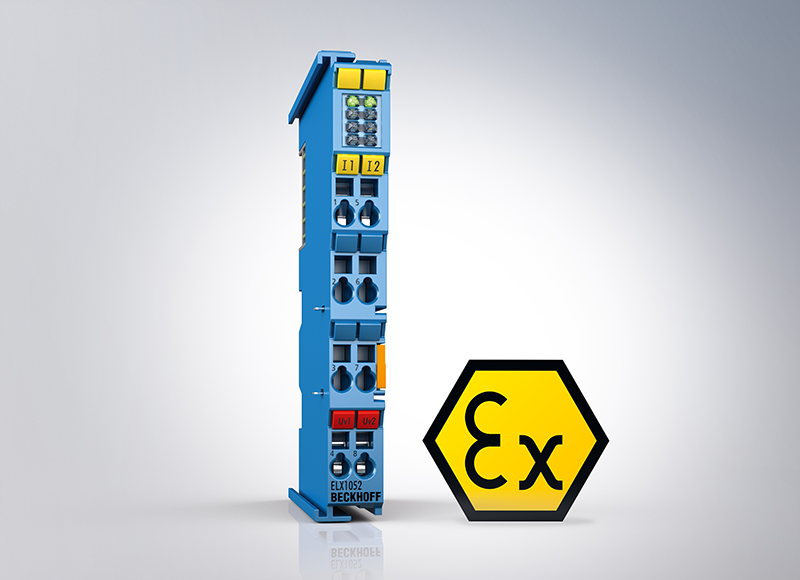
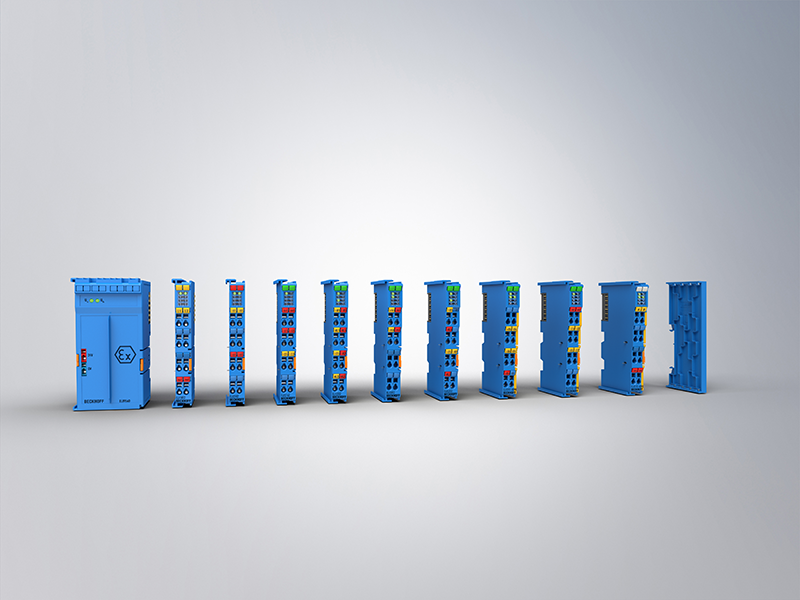
Intrinsic safety technology, such as the ELX EtherCAT Terminal series from Beckhoff, offers benefits in safety, cost, and ease of implementation.

2. Intrinsic safety is the least expensive way to implement explosion protection

In many cases, non-hazardous rated equipment can be used in an intrinsically safe circuit if it meets certain criteria. These devices are considered “simple apparatuses,” which means they are not capable of generating more than 1.5V, 100mA, or 1.5 W or they dissipate more than 2.5 W. These devices include thermocouples, switches, RTDs, and LEDs and are typically much less expensive and more readily available than hazardous area approved devices.

Another area in which intrinsic safety is less costly than other forms of explosion protection is the ongoing maintenance of the process or machine. Since they use energy limitation as an explosion protection concept, the devices in the hazardous area can be worked on without removing power. Additionally, maintenance time and effort can be significantly reduced because no gas clearance is required, and additional time is no longer needed to access electronics inside explosion-proof enclosures.

3. Intrinsic safety is the easiest explosion protection method to deploy

One of the biggest deployment advantages to intrinsic safety is the ability to use mostly safe area wiring practices. Of course, there are some wiring rules to follow, i.e., intrinsically safe and non-intrinsically safe wiring must be separated by 50 mm, and intrinsically safe wiring must be identified by a label or light blue cable jacket. However, all other aspects of wiring–when to use cable tray, types of glands, etc.–are similar to safe area wiring practices. This is in comparison to the multitude of rules regarding explosion-proof wiring installations, such as how and where conduit must be sealed as well as the type of cables and fittings required by the electrical codes. Intrinsic safety is also much easier to deploy than purge or pressurization systems as there is no need for a supply of inert gas to pressurize the enclosure nor the tubing and fittings associated with this gas supply.

The ELX series offers a range of intrinsically safe “blue terminals” for hazardous environments, enabling communication from Zone 0 up to the cloud.

Exciting technological advancements in intrinsic safety technology are making these deployments even simpler. An example is the integrated intrinsic safety in new EtherCAT I/O terminals. These components combine explosion protection with a standard, DIN-rail-mounted I/O terminal. Other vendors offer some sort of integrated approach to explosion protection, but many results in different form factors than their non-ex counterparts, and they cannot be integrated directly into the same I/O node with non-ex terminals.
The integrated approach provides many other benefits. For starters, it eliminates the need for a third-party intrinsic safety barrier. This not only greatly reduces the size of the enclosure that houses the control system, but it also cuts the number of time-consuming wiring terminations in half. This also eliminates the need to add another vendor to the bill of materials. Another noteworthy benefit of these integrated technologies is that engineers can take advantage of all the benefits of EtherCAT technology, including:

  • Real-time communication speeds at 100 Mbit/s and the EtherCAT G/G10 Gigabit expansions will soon offer even greater bandwidth for demanding applications
  • Free selection of topology without any impact on performance
  • Practically no network size limitations, with up to 65,535 nodes on a single EtherCAT network
  • High synchronization due to the principle of distributed clocks
  • Make your applications intrinsically safe today

In terms of safety, cost, and ease of deployment, the benefits of intrinsic safety are clear, and I/O technology advances series make this even more obvious. Engineers should evaluate whether this method fits their application and implement it as appropriate. It’s also important to work with technology partners that take the risks just as seriously as you do and provide solutions to help keep your team, company, and equipment safe.

(Courtesy of ISA/Beckhoff Automation and Author: Jesse Hill)

Sensor Integrity Ensures Temperature Measurement Accuracy

Sensor Integrity Ensures Temperature Measurement Accuracy

Although not every temperature application is a high-accuracy mea¬surement, best practices can be applied to eliminate sensor drift at the start of an installation. This helps users achieve optimal results while avoiding downtime or troubleshooting that might result from future drift during operation.

Several factors influence temperature system accuracy: individual sensor accuracy, extension wire, and measuring devices. When embarking on a project involving temperature measurement or control, consider these basic rules of thumb:

  • The same techniques used to achieve accuracy also result in curbing measurement drift.
  • Specifying the appropriate sensor will keep drift to a minimum.
  • Selecting the appropriate transmitter will keep drift from occurring.
  • Using 4-wire RTDs will eliminate the possibility of measurement drift. (Even if using direct-wired 3-wire RTDs, solutions exist to minimize lead wire drift.)
  • Reduction in drift means fewer calibrations/verifications, which translates to lowered operating expense.
  • Thermocouple extension wire decays over time, causing measurement error, in the form of drift, and requiring replacement.
  • Many of the considerations above have trivial impact on the initial purchase price and offer very significant impact on cost of ownership

The most common temperature sensors acceptable for temperature measurement and control include thermocouples, resistance temperature detectors (RTDs), thermistors, and semiconductor-based sensors. Only T/Cs, RTDs, and remote input/output (I/O) are discussed here.

Thermocouples

Thermocouples (T/Cs) are the most common temperature measurement sensors used in the U.S. for process control. T/C use is a proven technology in the industry. They are rugged, relatively inexpensive, and easy to use.

Figure 1: Solid sheath RTD or thermocouple temperature sensors.

When metals of different compositions come into contact, they form a junction that produces a voltage in the millivolt range. If the temperature to which this junction of dissimilar metals is exposed changes, there will be a corresponding change in the millivoltage produced by the junction.

Thermocouple types

Theoretically, any two different types of conductive material could be used to make a thermocouple. However, only a few combinations are used. The criteria for the material combinations chosen for use in thermocouples include the magnitude of their relative Seebeck coefficient, chemical stability, metallurgical stability, strength, ductility, and cost.

There are eight standard thermocouple types established in the U.S. The American National Standards Institute (ANSI) assigned letter designations to these eight types: T, J, K, E, N, S, R, and B (Table 1). The designations are based on the voltage versus temperature relationship for these thermocouples. The designations are not based on their compositions. T/Cs built to the ASTM E230 standard are more accurate. The ASTM E320 standard governs thermocouple accuracy.

T/C sensor accuracy

Thermocouple sensors built to the ASTM E230 standard are more accurate. The ASTM E320 standard governs thermocouple accuracy, as shown below in Table 2.

Premium/special grade thermocouple wire

Thermocouples can be constructed with premium- or special-grade wire that cuts uncertainty in half. The premium/special designation indicates that this wire has a higher purity alloy mix. Even with premium/special grade T/C, Moore Industries recommends using RTDs instead of T/ Cs whenever possible, as their accuracy, repeatability, and stability are superior to those of T/Cs.

In comparing the accuracy data between Table 3 and Table 2, notice that the uncertainty is cut in half by using premium-grade sensors. If T/Cs must be used, premium grade offers greater stability at a negligible cost difference. The problem consistently seen in thermocouples is wire contami¬nation. As contamination occurs, error gradually increases to a point necessitating sensor replacement.

T/C extension wire characteristics

Anytime T/C extension wire is connected to a T/C, it introduces more uncertainty to the measurement (Table 4). If T/C extension wire will be exposed to temperatures outside the specified ranges, consider using actual thermocouple wire instead.

In addition to uncertainty, T/C extension wire is susceptible to radio-frequency interference (RFI) and electromagnetic interference (EMI). Extension wire for J and K thermocouple types adds another ±2.2°C (±4.0°F) uncertainty when wire is clean and uncontaminated. Also, T/C extension wire tends to behave as an antenna for RFI and EMI. Use best practices to keep disruptive noise out of these low-level mV signals. T/C extension wire will degrade to the point of replacement; replacing it with more extension wire perpetuates the T/C extension wire replacement loop. However, premium-grade T/C extension wire cuts the potential error in half and should be selected.

If the extension wire is stressed by being exposed to temperatures outside the limits shown in Table 3, uncertainty will grow. Premium-grade extension wire still allows the possibility of error once metals become contaminated by airborne influences. It is recommended that T/C extension wire be eliminated as close to the T/C as possible by installing either temperature transmitters or remote I/O.

Options for eliminating T/C extension wire

Options exist that allow the elimination of T/C extension wire, thereby taking a step in ensuring reliable measurements. Among the options are temperature trans¬mitters, which can pose cost considerations, and remote I/O.

Temperature transmitters, remote I/O, and temperature concentrator modules eliminate expensive T/C and RTD extension wire and other point-to-point wires by sending temperature measurements, process monitoring, and control signals between the field and control room on one digital communication link. Related technologies, such as temperature concentrator modules (TCMs) and temperature transmitter/signal converters, have programmable inputs configurable for RTD, T/C, Ohms, mV or potentiometer, and current or voltage, depending on the specific module type. Outputs would often support HART, PROFIBUS PA, FOUNDATION Fieldbus, MODBUS RTU, etc.

Typical characteristics of state-of-the-art remote I/O include:

  • Minimum hazardous area certification of Class 1, Div. 2/Zone 2
  • Ambient temperature specs -40 to 85°C (-40 to 185°F)
  • Each input configured, calibrated, and custom-trimmed individually, as with temperature transmitters
  • A 20-bit input resolution and input accuracy equivalent to that of temperature transmitters
  • 500 Vrms isolation in all directions
  • Sensor and I/O diagnostics
  • Serial, Ethernet, or wireless communication capability supporting open protocols such as MODBUS RTU, MODBUS/TCP, PROFINET, and EtherNet IP
Figure 2: Complete temperature assemblies using the WORM flexible sensor and an infinite combination of materials and components.

Resistance temperature detectors

RTD wire is a pure material, typically platinum, nickel, or copper. The material has an accurate resistance/temperature relationship, which is used to provide an indication of temperature. RTD elements are normally housed in stainless steel protective probes insulated and isolated from a protective sheath with magnesium oxide.

Common RTD sensing elements constructed of platinum, copper, or nickel have a repeatable resistance versus temperature relationship (R versus T) and operating temperature range. The R versus T relationship is defined as the amount of resistance change of the sensor per degree of temperature change. The relative change in resistance (temperature coefficient of resistance) varies only slightly over the useful range of the sensor.

Premium- and special-grade RTD sensors

Moore Industries thermally ages all of its RTDs to minimize drift once they get into the field. The RTDs are temperature cycled for 1,000 hours at 0° and 600°C, and will maintain accuracy for more than five years. Typically, only Class A sensors are thermally aged. Just as it is recommended that you use premium-grade T/C wire for thermo¬couple measurements, it is also suggested that you upgrade to Class A RTD sensors, which cuts uncertainty in half.

Sensor trimming for high accuracy

When a particular application demands the highest accuracy possible, Moore recommends ordering a temperature measurement system with bath calibration. A Class A RTD sensor is calibrated in a bath to calibrate it to the transmitter or remote I/O measuring device. This process eliminates the final “as-built” offset error that exists in every sensor. You then receive a NIST-traceable calibration report that indicates the combined sensor and temperature transmitter uncertainty, which is typically better than ±0.01°F.

Figure 3: The WORM RTD or thermocouple temperature flexible sensors with flex armor or stainless-steel braid covering the insulating jacket.

Effects of RTD extension wire on accuracy

The 1,000 Ω platinum RTD “secret.” If you must stay with 3-wire RTDs and you have long leads back to the DCS, consider replacing 100 Ω Pt RTDs with 1,000 Ω Pt RTDs. When this is done, the error caused by the resistance imbalance in the lead wire is reduced by a factor of 10.

Figure 4: By replacing 100 Ω Pt RTDs with 1,000 Ω Pt RTDs, the error caused by the resistance imbalance in the lead wire is reduced by a factor of 10.

Sensor selection summary

To optimize measurement performance and minimize long-term maintenance expenses, use the following guide for sensor selection:

  • Use an RTD when measuring in ranges between -40°C and 850°C (-40°F and 1562°F).
  • For temperatures as low as -200°C (-328°F), use a wire-wound RTD.
  • Best practice is to use 4-wire and Class A RTDs.
  • Make sure sensors are temperature cycled and “aged” for long-term stability.
  • When applying RTDs below 0°C and above 600°C, know the process conditions to optimize the build: temperature range, cycling, pressure, flow, media, vibration, and surrounding environmental conditions (chemicals/atmosphere).
  • When highest accuracy is needed, use sensor trimming.
  • If using 3-wire RTDs with long wire runs, and using 4-wire RTDs is not possible, replace the 3-wire RTDs with 1,000 Ω platinum RTDs.
  • For temperatures above 850°C (1,562°F), use thermocouples.
  • If using thermocouples, use premium-grade thermocouples and extension wire.
  • Make sure long thermocouple extension wire is noise protected.
  • Replace contaminated T/C extension wire with remote I/O.

Final thoughts

All temperature measurements, whether used for temperature indication or process control, begin with the sensor. Thermocouples and RTDs are the most common temperature sensors used in industrial applications. Temperature transmitters, remote I/O, and temperature concentrator modules eliminate expensive T/C and RTD extension wires and other point-to-point wires by sending temperature measurements, process monitoring, and control signals between the field and control room on a digital communication link.

Refer to Moore Industries Temperature Reference Guidebook for more information. This feature originally appeared in the May 2022 issue of InTech Focus Temperature & Pressure.

(Courtesy of ISA/Moore Industries and Author: Gary Prentice)

Cybersecurity for Electric Energy Infrastructure

The U.S. Department of Energy (DOE), global equipment suppliers, and other stakeholders announced the establishment of the Electric Energy OT Security Profile working group hosted by the ISA99 standards committee. The Electric Energy OT Security Profile will be a cybersecurity work product using the ISA/IEC 62443 series of standards. The final product will be a formal ISA/IEC 62443 application guide, recognized globally as the consensus work product for securing various control systems used in electric energy generation, transmission, and distribution operations.

The ISA/IEC 62443 series of standards is designated as a horizontal standard, applicable to many industry sectors and applications. Industry groups use the ISA/IEC 62443 standard series as the basis for securing industrial control systems. DOE’s Securing Energy Infrastructure Executive Task Force (SEI ETF) evaluated available industry standards and recommended the electric energy operational technology (OT) applications be formalized as ISA/IEC 62443-5 security profile applications—gaining international energy sector consensus on applying ISA/IEC 62443 to electric energy OT applications.

The working group is seeking participation from industry groups, including the Institute of Electrical and Electronics Engineers (IEEE), the International Electrotechnical Commission (IEC), the International Council on Large Electric Systems (CIGRE), and other industry stakeholders, to ensure consideration of and alignment with other cybersecurity work product development efforts. The initiative will use the DOE SEI ETF’s Reference Architecture and Profiles for Electric Energy OT as a foundation.

“The Securing Energy Infrastructure Executive Task Force developed an OT-specific reference architecture for electricity systems to provide a common language for control system environments that can be used to design and assess security applications,” said Puesh Kumar, director, DOE Office of Cybersecurity, Energy Security, and Emergency Response (CESER). “The ISA working group represents an opportunity to validate these profiles and put them into practice for the energy industry. CESER is excited to see energy sector stakeholders carrying forward the task force’s reference architecture work.”

Eric Cosman, co-chair of the ISA99 Standards Committee, noted that “Global standards and supporting specifications provide efficiencies for end users, product suppliers, and system integrators that design, deliver, and support products and systems all around the world. One specification and one globally recognized certification provides needed transparency and reduces the regulatory burden on manufacturers.”

EnQuest Wins ISA100 Wireless Excellence Award

The ISA100 Wireless Compliance Institute presented its ISA100 Wireless Excellence in Automation Award for 2021 to EnQuest, an oil and gas production and development company with operations in the U.K. North Sea and in Malaysia. Managing director Andre Ristaino presented the award at the ARC Forum conference in Orlando in June.

ISA100 Wireless logo

ISA100 Wireless, also known as international standard IEC 62734, is an open, universal IPv6 wireless network protocol that establishes the Industrial Internet of Things. IPv6 addressability makes ISA100 Wireless the only industrial network protocol compatible with the Internet of Things. The ISA100 Wireless Excellence award is presented each year to an end-user company that has demonstrated outstanding leadership and innovation in the use of ISA100 Wireless technology.

The 2021 award was presented to EnQuest for its Sullom Voe Terminal in Scotland and its novel application of ISA100 Wireless technology for new approaches to gas detection and achieving a safe and secure gas detection system upgrade on a vast scale. Cybersecurity and reliability were key considerations in the gas detection system upgrade.

EnQuest’s Sullom Voe Terminal is located at the northern end of the largest of the Shetland Islands and is one of the largest oil terminals in Europe. It handles production from many oil fields in the east and west Shetland Basin in the North Sea. Fourteen different companies have ownership interests in the terminal, which receives production through the Brent and Ninian 36-in pipeline systems.

Previous award recipients include Fuji Oil Company (2020), ILBOC (2019), BACPO (2018), ALCOA (2017), Phillips 66 (2016), Petronas (2015), Nippon Steel (2014), and RasGas (2013). 

Find out more through the ISA100 Wireless Interest Group on LinkedIn.

Updated Schedule for ISA Fall Hybrid Events

Image of a virtual convention hall.

New virtual events with in-person components provide convenient attendance and live networking opportunities. The live components of the events are supported by ISA sections and/or regional partners. The locations shown indicate the time zones during which the virtual events will take place. Find out more and register.

ISA Automation & Leadership Conference: In Texas and Online in November

A new event that combines ISA’s annual leadership conference with two days of technical presentations will welcome attendees both online and in-person in Galveston, Texas, in November. The three-day event, 7–9 November, will be held at the Galveston Island Convention Center. It combines workshops and association meetings with presentations on important industry topics like digital transformation, cybersecurity, the Industrial Internet of Things, smart manufacturing, and process automation.

(Courtesy of International Society of Automation: InTech News)